Salon Theology 101

I love getting my hair cut. Not because it always feels great to have the split ends removed and to have an inch or so trimmed off, giving my hair my bounce and body. (Okay, I am beginning to sound like a commercial for hair products!)images.jpg

I love getting my hair cut because of the conversations I have with my hairdresser—conversations that go beyond what conditioner to use or how to tame frizz. The conversations we have are conversations we all should be having. They are the conversations about life, love and faith. They are conversations about what it is that makes us who we are. Yesterday I had one such conversation with my hairdresser.

As her scissors worked their magic we got to talking about respect, more like the lack of respect we see towards one another. We got to talking about how no one is addressed anymore as Mr. or Mrs. or Miss. Rather first name basis is now a thing for strangers and casual acquaintances alike. We then went on to share experiences in schools and churches where often titles as Dr., Prof., Rev. and Pastor aren’t used much either.

Perhaps that is why I have such a fondness for rural ministry as it seems in such a setting there are still remnants of a time gone by where folks are still addressed as Mr., Mrs., Miss, Dr., and Prof. I recall many times an adult correcting a child that I was not “Donna” but “Pastor Donna.” At first I was surprised at the correction as I have never seen that happen till serving a little rural church in upstate New York. It was refreshing. But lately, we got to wondering what happened to the use of such identifiers.

Now this conversation wasn’t a gripe session. Far from it. This conversation was more in line of two people trying to make sense of the horrific violence in our world without having to speak of such violence, because how much more can our broken hearts take by once again trying to discern the shootings that have taken more black lives. Yes, I am making the point that these men were of color. Because if we just say “lives” and if we argue against the “Black Lives Matter” slogan, stating that “ALL” lives matter, then we are not being realistic as to how great the problem of race still is in our country. We are fooling ourselves in thinking we have nothing to do with it.

I don’t know. Maybe it was easier for us to speak in code and focus on the umbrella topic of “respect” then having to really dive deeply into the ugly, harsh realities of our world. But maybe we have to dive deep into the muck before we can even think about bopping our heads up to the safe, serene surface we so desperately seek.

It was then my hairdresser said, “How do we expect people to respect one another when we don’t even respect ourselves?”

I had to pause and ponder. She was on to something here. Could it be humanity’s brokenness has gotten to the point where we are lashing out at one another? Could it be the stressors of living are finally making us snap? Could it be we are so unhappy with ourselves that the only way to have some sort of pleasure is to look at another as lesser than and to treat another as lesser than?

I’m not sure. I’m just sharing the thoughts I’m encountering as I dive into the muck, hoping to learn something that will bring me back to the clear, serene surface.

My hairdresser’s words stayed with me much longer than the smooth, blowout I left the salon with. As my hair quickly reverted to its natural state of waves and frizz, I wondered what did God have to say about “respect”?

Remembering a question from my ordination exams long ago which asked about the role of authority, respect, treating one another, etc., I knew to begin my search by turning to 1 Peter. And there it was (the following are excerpts from 1 Peter 2, as presented in The Message):

Make the Master proud of you by being good citizens. Respect the authorities, whatever their level; they are God’s emissaries for keeping order. It is God’s will that by doing good, you might cure the ignorance of the fools who think you’re a danger to society. Treat everyone you meet with dignity. Love your spiritual family. Revere God.

Respect for others.

Respect for self.

Respect in general.

It seems to me that it begins with us first respecting God. It seems to me we need to remember the earliest command in the Mosaic law in which Jesus highlighted beautifully how it is lived out when he told the parable of The Good Samaritan.

It goes something like this:

A lawyer knowing the Mosaic law intimately asks Jesus, “Teacher (notice, the respectful title given to Jesus), what must I do to inherit eternal life?”

And Jesus reminded him of the law, “Love the Lord your God with all your passion and prayer and muscle and intelligence—and love your neighbor as well as you do yourself.”

Notice the “love yourself” thing that is linked to the love your neighbor thing.

But then the lawyer asks, “Who is my neighbor?”

Could it be the lawyer knows he is guilty of not loving everyone? Could it be he is hoping Jesus will say specifically who you can and cannot love and still be good with God?

It’s a good question that I am going to let linger there without an answer. You ponder it. But before you do, first ask yourself the respect question.

For my hairdresser was on to something when she asked, “How can we respect others when we don’t even respect ourselves?”

Well, thanks for entertaining my thoughts for today. I have another hair appointment in six weeks. So stay tuned for more Salon Theology 101.

Postscript

This was written before the news of the shootings in Dallas that have left five police officers dead. Prayers for all who mourn this day. Lord, in your mercy, hear our prayer.



Into the Deep End of Gladness

The place God calls you to is the place where your deep gladness and the world’s deep hunger meet.

Frederick Buechner

Not sure why I wrote this quote in my journal. It wasn’t as if I’ve never heard it before. I had. Many times over. There I was, though, scribbling it down as if the words were brand-spanking new to ears I thought were deaf by now to such pithy quotes. The longer you’re in ministry the longer the list of these quotes seems to get.

I scribbled and reread it. Then I underlined “deep gladness” and read it some more. Next, I circled “deep hunger” and read it yet again. Then “God,” “call,” “meet.” The words were taking on an exciting new life. The speaker at the clergy conference I was attending continued as I gazed down at the fresh ink marks made on the soft gray lines of the bright white journal paper.

“If you don’t know where your deep gladness is—find it,” he commanded, emphasizing “find it” with enough power and punch to get his point across.

It was then my pen jumped at his command and began dancing across the page of my journal. Like the Bible story about the writing on the wall mysteriously appearing in the courts before King Belshazzar that mesmerized me as a child I, too, looked at the words before me wanting to know what they meant, for it was a message I didn’t quite understand or, better yet, didn’t trust to be true.

The mysterious words were, “I do know.”

Really? I do know where my deep gladness has the ability of meeting the world’s hunger?

I thought some more about the divine message that I could no longer ignore—or even erase from my journal. Darn. I knew I should have written this down in pencil! But the truth was let loose.

I did know where my deep gladness was. I knew, but some where and some how I had let life get in the way. How strange it is that the things we need to do in order to “live” are often the very things robbing us of deep gladness? If only we were more aware of that which makes the heart leap for joy would we then start seeing God’s kingdom becoming a beautiful reality in our midst.

This is especially true of our faith communities where, in sacred spaces and on holy ground, time and energy is spent trying to solve the problems of low attendance and little money. Focus on what is thought to give new life, though, actually thwarts the new life Jesus is offering. What is all too soon forgotten is revival begins first by reconnecting with one’s deep gladness. And this deep gladness is always accompanied with the gifts, talents, resources, energy, etc., needed to satiate a hungering world.

Yes, the place God calls you to is the place where your deep gladness and the world’s deep hunger meet. Find that deep gladness now, for the world is indeed hungering.

IMG_0488.jpg

Deep gladness is found out in God’s big backyard where the accidental country pastor’s passion for rural ministry meets the hungering needs of small churches.

The Hallowed Halls of ‘Back Then’

It’s a humid and gloomy afternoon. The kind of afternoon in which you just want to sleep away, but I don’t dare pull the covers over my head. I have a sermon to write, to which I’m failing miserably at.

It seems my mind has a mind of its own. It doesn’t want to help me out in coming up with any eloquent prose on the significance of Jesus casting out many demons plaguing a man.I keep wondering why Jesus just didn’t vanquish the demons? Instead, he relocated them to live in a bunch of unsuspecting pigs who were, up to that point, enjoying life—as much as a pig can enjoy life before becoming a slab of bacon.

Can I really write a sermon sympathizing with the pigs? Probably not. I do love bacon. So I say to my mind, “Take me where you want to go.” It does so happily, taking me away from the here and now and into the hallowed halls of “back then,” where memories have the power to either sadden or gladden. I anticipate both happening. For the back then I go to is a country wedding taking place in a little white church five years ago this week.

I can see the sun shining brightly behind the soaring white steeple. Its rays have chased away all of the drizzle-filled clouds that had me, the bride-to-be, biting my manicured nails.

I can see the sanctuary graced with flowers from the gardens of all the dear women who insisted that flowers were needed in each of the windowsills of the old church. Right before the organ begins the first notes to the bridal procession, I smile with approval at one of the white-haired ladies smiling back at me.

This was one occasion I was glad she didn’t listen to me when I said we didn’t need flowers in the sanctuary. We did need them. I needed them. For they weren’t flowers bought from a florist, arranged in a stiff, artificial way. They were flowers collected with love from local fields and hills and gardens, gathered in bunches and placed in vases that have been hanging around the church for countless years. I bet those vases were happy to be out of the cupboards and once again part of a memory-making day.

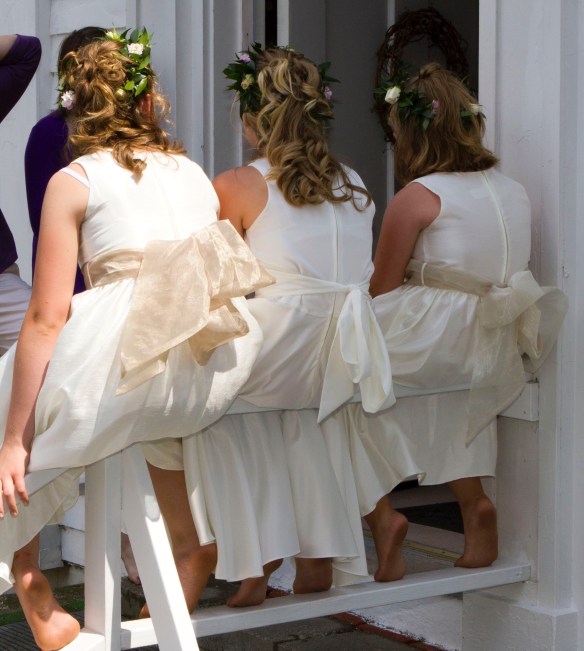
I can see the many flower girls. They are a picture of perfection with their floral wreaths in their hair and their cream colored dresses tied with champagne-colored sashes. Perfection is fleeting though. Soon shoes come off, sashes untie and floral wreaths wilt as the girls play outside on the church lawn. In these hallowed halls of “back then” I spot a picture and stop and stare. Some of the girls are sitting on the wooden rail, with dirty bare feet telling of one fun afternoon. There’s that gladness mixed with sadness, as time has turned these girls into young ladies. That means, I too, have grown older.

I can see the tables in fellowship hall filled with homemade treats that would put to shame feasts typical at an Amish barn raising. I can see my mom and dad beaming with joy. I can see my husband’s parents smiling, with a tear or two. I can see the family of faith gathered who that day became more of a family than I had ever realized. I can see my sister and my new teenage daughter standing together as bridesmaids, bonding over all the stress I put them through in finding the right shade of antique pink for their dresses. And I can see the man God had waiting for me through all those years of heartache and loneliness. There he is standing at the front of the church, my friend, my partner, my love, waiting to begin life together.

I can see it all. And if I allow myself to enter more deeply into the hallowed halls of “back then,” I don’t only see. I can smell those flowers collected with lots of love. I can hear the flower girls laughing on the lawn of the church. I can feel my father’s hand as I grabbed it tightly to walk down the aisle with him. I can taste the rich vanilla in the wedding cake baked by a friend from a neighboring church. I can feel the hugs of all those who have journeyed with me. I can hear God whispering a promise I had often been deaf to.

I am with you…always.

I drift back to the gloomy here and now. I am gladdened and saddened. Where have the five years gone? I wonder about decisions made. Things I could have done differently and should have done differently. Words that should have been said and should have never been said. Dreams still being dreamed and hopes still being hoped. Home still waiting to wrap its arms around me and my husband.

My mind is not quite ready to focus on Jesus, demons or pigs, so I linger a bit more in the hallowed halls of back then, realizing I do so not to live in the past. I do so in order to gain strength for the future, to remember God who has done so much for me is not yet done with me. It’s to help me hear God’s whispered promise of being with me that I need to hear especially on these gloomy here and now kind of days.

flowergirls

A picture from the hallowed halls of “back then”…a country wedding in a little white church, where flower girls played all afternoon on the church lawn.


After 2 A.M.

Nothing good ever happens after 2 a.m.

The song’s lyrics on the radio leaped out at me. “That singer is right,” I said to my husband, whose eyes were fixated on the road leading us back home to the slumbering bucolic hills and valleys of Vermont. “Nothing good ever happens after 2 a.m.”

My husband looked at me strangely, wondering where I’ve been that I had never heard what turned out to be a popular old saying that he knew quite well.

Less than 48 hours later, the saying I had just become acquainted with had sadly been verified. The news broke a peaceful Sunday morning into a million shattering sharp pieces.

2:09 a.m.—A man armed with an assault rifle entered an Orlando night club. Shots fired. 50 reported dead. 50 more injured.

Nope, nothing good ever happens after 2 a.m. Or for that matter, nothing good happens at 9:30 a.m. as we saw in an elementary school in Connecticut; or 9:25 p.m. when news of shooting in Parisian restaurant came our way; or 8 p.m. when we learned of the carnage happening at a Bible study in a Charleston, S.C. church.

I don’t need to go on any further because I’ve made my point. And, anyway, I have to stop for my stomach is getting queasy and my eyes are filling with familiar tears that I have cried one too many times in one too many cases for one too many senseless killings. Nothing good ever happens…at any given time these days, so it seems.

Shortly after news of Orlando seeped into our quiet Sundays, I read a posting on social media blasting the lack of outcry over the lives lost in the dreadful after 2 a.m. hours of the morning. The person cried that the lack of attention given was because those gathered were gathered in a gay nightclub. I’m not discounting that there is some truth to that. But I did disagree with this person because perhaps the lack of outcry was not due to sexual orientation.

Perhaps many were not being vocal because such news has become all too common. Dare I say that we are slowly becoming desensitized to it all. Yes, there is a feeling of anger, of outrage, of fear, of sadness, of confusion. In the midst of all these emotions, though, no one has really addressed or unpacked the most dangerous of all emotions: helplessness, which leads to the No. 1 killer of hope in the world—complacency. And so, silence begins to happen as we sit and wonder, “What can I really do?” and “Does my voice even matter?”

As I skimmed the reactions on social media, I found myself getting perturbed at the postings calling for “prayer for the victims.” And I, a pastor, cringed at the news of prayer vigils popping up all over the place. It’s not that I’m against prayer nor has all of this violence in the world turned me into an atheist.

Prayer can and will change all circumstances. Prayer is not something we turn to only AFTER a tragedy strikes.

Where are the prayers that need to be said for a broken world before the brokenness decides to rear its ugly head in some catastrophic way?

Where are the weekly gatherings in which God’s children listen to the whispers of holy instructions that speak of loving one another and forgiving completely?

Where is our commitment to pray to God for help, wisdom and the strength to be the blessed peacemakers in this world?

Where are the prayer circles that gather before tragedy strikes, thus, making prayer vigils obsolete?

Every Sunday night a dedicated few would gather for prayer in the chapel of the little white church I served. There we would sit. In the heat of summer, the door would be open allowing a breeze to blow through along with the black flies. In the cold of winter, we would keep our coats on for we wanted to be good stewards of the building and keep the church’s heating costs down.

Sometimes we just sat awkwardly in silence. Sometimes we named a concern. Sometimes we prayed for others. Sometimes we even prayed for ourselves. But all the time, no matter what was said or not said, we left renewed with hope. We left in awe with gift of feeling the presence of God.

Did these prayer circles change our church? Yes, they did.

Did they change the community? I think so.

Did they change the world? Some people would say no, they didn’t. But they changed each one who attended. And that change, no matter how insignificant it might seem, is the change that will ultimately change the world. One person, one heart, one prayer at a time, that’s how a seemingly invisible God becomes visible to others.

And that’s where we have to start. Because nothing good ever happens after 2 a.m.—or 9:30 a.m. or 9:25 p.m. or 8 p.m. There’s a world growing darker with hate. Tragedies will occur anytime, anywhere. We, though, don’t have to let helplessness turn into complacency. We have a choice.

We can continue to gather in prayer vigils after the darkness has covered us, or we can turn to God before our times of trouble. We can pray, encircled together, for love to win and for peace to shine brighter than any darkness.

It’s time for more prayer circles and fewer prayer vigils.

Blessed be those who mourn this day, for they will be comforted. Matthew 5:4

IMG_5271

The “little white church” where Sunday prayer circles did have the power to change the world—opening one heart to God’s Spirit at a time. 

Soaring High

It’s been a while since I’ve been on a business trip. One that involves getting on an airplane. Here I am, though, sitting at the gate waiting to board my flight.

I glance down at the bag of overpriced goodies sitting on top of my tote bag. Gummy bears, a pack of gum, a bottle of water and a magazine or two. All were my travel standbys back in my magazine days when I was jetting off to exotic places such as Africa and Thailand as well as the not so exotic such as Fayetteville and Manhattan (Kansas, that is, home of the Little Apple).

Back then I was in search of the next big story. I was in search of the next big promotion. I was in search of the next big what’s next in my life. I would board the plane and settle into my favorite seat right by a window. I would snap tightly my safety belt and do the obligatory check for the nearest emergency exit. Then I would wait. I would wait for the plane to begin its race down the runway, enjoying the sense of speed and power, until finally it lifted off high into the clouds. I could feel my hopes and dreams soaring as well.

The excitement. The anticipation. The sense that God was not done with me yet. (Oh, yeah, thrown into my tote bag were not just the overpriced goodies. My tiny tattered travel Bible came with me as well.)

Back then I was in search of the next big what next in my life. And back then I knew with God the next big what next would be a beautiful reality.

Now?

Often at times I wonder about the possibility of all things being possible. Will my fledgling someday farm actually become all that I have sketched it to be on paper? Will I run a marathon? Climb mountains? Change lives? Make a difference? Will I…

What is this doubt and questioning? I don’t know who this me is, for I’ve never wondered before about God’s ability to answer the cries and desires hidden in the deepest part of one’s heart. Before I would let my heart cry out and allow my dreams and hopes to soar with trust in God, soar just as high as the planes I travelled on soared.

Now?

Perhaps this is what growing older does to a person. I’ve heard with age comes wisdom. Is this wisdom, though, the culprit in welcoming a cynicism that turns against God’s possibilities? I want to ask wisdom, “How true of a friend are you?”

Back then I was in search of…and I found it.

Now what am I in search of? More importantly where is my faith in God that I will indeed find all my heart is crying out for?

Gummy bears, a pack of gum, a bottle of water and a magazine or two…and my tiny tattered traveled Bible—they’re all in my tote bag, again.

I’m at the airport traveling on business. It feels good to reconnect with my younger self. But it feels even better knowing soon I will be seated by the window where, after clicking on my safety belt and doing the obligatory check of the nearest emergency exits, I will look out into the clouds and allow myself to dream the impossible dreams once again. I will soar beyond all that has kept me down. I’ve done it before. Back then. And with God, I will do it again. Here and now.

My Someday Farm

IMG_2244

Sofie, Pastor Donna’s bumbling Bernese Mountain dog, sits on top of the hill, taking in the view of the accidental country pastor’s someday farm. 

Morning had broken. I threw on my Mucks and barn coat and, with a steaming mug of coffee in hand, went out into the crisp air to start the day with my version of a breakfast for champions—a hearty prayer walk.

Who needs Wheaties when God can nourish you?

The sun was breaking through the fog hanging low in the valley and the wind was shooing away the last remaining clouds trying their best to conceal the Green Mountains of Vermont.

I let out a sigh of contentment. This scene always brought joy to my heart, taking me back to a long-ago visit to my father’s homeland of Switzerland.

It was there a young girl with golden pigtails held her dad’s hand as they walked the hills blanketed with so many wildflowers that not a patch of green grass could be seen.

It was there a young girl would sense already in her life the awe of God’s hand at work in nature, watching as the billowy clouds wrapped around the mountains that seemed to embrace the quintessential Swiss homestead with mystery and grandeur.

It was there a young girl, full of big dreams for the tomorrows yet come, said to her father, “Someday I’m going to have a farm just like this.”

My breakfast of champions—my prayer walk—came to a stop as I noticed I was not alone. The shadow of that young girl with the golden pigtails was walking with me. I stopped and stared and heard my father’s voice as clear as if he was now standing right beside me.

“Someday you will. I’m sure of it.”

That’s what he said so long ago to that young girl with big dreams, big hopes, big prayers.

Some how. Some way. Someday….

Was now.

For some where along the way, without even realizing it, God had been answering me. I was now standing smack in the middle of my someday farm. Sure, to others all they would see were acres of nothing. But my eyes, finally opened to what was possible in the midst of impossibilities, saw it.

I could see the barns that yet stood. The coop yet built. The pond yet to be dug out of the forever wet and marshy piece of land that was such an eyesore to me. I could see the fruit trees not yet planted. The garden not yet tilled. They were all there. I finally saw a young girl’s dreams, hopes, prayers, being answered.

How many times, though, had I walked this walk and never once realized my some days were always right there waiting for me to act on?

I reached my hand towards my shadowy companion, hoping in some miraculous way I could touch not only the hand of that young girl I once knew, but reconnect with her awe in God who embraces us always with his mystery and grandeur. Perhaps if I could hold that young girl’s hand, the one with the golden pig tails, grown up fear and skepticism would give way to childlike trust and faith.

I reached but couldn’t grab. The past is elusive. So instead I reached my hand towards heaven to grab hold of the beautiful here and now God was revealing.

What are the someday prayers and the someday dreams you’ve prayed and dreamt? Could they perhaps be right in front you waiting for you to finally see?

Some how. Some way. Someday…

Is now.

For our Father’s voice whispers to the heart that dreams big, hopes big, prays big, “Someday you will. I’m sure of it.”

A Little White Church Good Friday Reflection

It was a powerful night for those gathered at the little white church to do something different for Maundy Thursday. They gathered in the fellowship hall, better known as Mackenzie Chapel, named so after the man whose grim looking picture, hanging on its walls, had caused many a child to ask, “Pastor Donna, are his eyes following us?”

Of course, they were teasing me claiming that the famous friendly ghost that haunted the school came down the street for an occasional visit to the church. There was plenty of hallowed ground in the little village with a Revolutionary War cemetery greeting visitors upon their arrival as well as stories of which old house was indeed an underground railroad stop.

But on this holy night an intimate group gathered in the chapel for something different: a quiet candlelight supper to recall the Passover meal Jesus celebrated with his disciples on the night of his betrayal and arrest.

It was powerful as we gathered and got to better understand the symbolism in the items on the traditional Seder plate and how Jesus was about to add a layer of new meaning to what was with what was about to be.

The bitter herbs of tears shed long ago in Egypt foreshadowing the bitter tears that would be shed at the foot of the cross. The lamb sacrificed for the meal foreshadowing THE lamb to be slaughtered. The last cup of Passover wine now the cup of the new covenant poured out in Jesus’ blood—there was a strong sense of the Spirit moving among those at the table who came seeking deeper meaning and deeper understanding. We were not just on hallowed ground. We were standing on holy ground. Together. And there were angles all around.

As was recorded in scripture, we then, too, sang a hymn after supper and made our way outdoors. The sweet smell of a spring night was strong. The daffodils and hyacinths from Easters past, planted by the white picket fence of the church’s parking lot, were in full bloom. A bird fluttered by and in the silence of the circle we made a little girl couldn’t contain her excitement any longer.

“Mommy, listen to the peepers!”

The beauty of God’s creation was all around us and yet we were outside to remember the agony of Jesus who, in night air similar to ours, prayed to his Father to take this cup of suffering away.

With the chorus of peepers in the background, I read the words I knew those in the circle have whispered or pleaded or cried out many times before. I read the words that were at times in my life all too familiar.

“Father, please let this cup of suffering pass. But not according to my will, but your will be done.”

The words wafted into the air. We closed in prayer. The stars appeared.

I will always remember that night for those gathered at the little white church because it was a night in which they dared to do something different in terms of worshipping God. To do something different not to attract more people, but do something different that was born out of the desire to have a deeper and quieter prayer experience on such a holy night.

It was a powerful night.

But how many powerful nights like that have we missed all because we went along with the crowd and didn’t listen to how our Spirits needed to be fed?

I have come realize more and more the worse thing we can do individually or collectively is squash the Spirit of God by not listening to what the Spirit is calling us to do—even if it means doing something different, even for just this one time.

And so as I stare at today’s wooden cross in a time of prayer on this Good Friday, I remember one powerful night at the little white church. I remember a little girl’s excitement at the peepers. I remember the incredible sense that we were together standing in the presence of the Holy One. I remember our prayers. But most of all I remember the divine silence.

I look at the cross of Good Friday and I remember my need to be true to God and be who God is asking me to be. I realize, too, for God to truly work through me, I need to do something very important.images-1.jpg

I need to nail to the cross my fears and doubts and insecurities. I need to leave behind that little voice that says, “You can’t do…” this or that.

For isn’t the cross our reminder of ALL God CAN do?

On this Good Friday I remember one powerful night at the little white church that changed me, shaped me and inspired me.

It is now time for me to once again be changed, shaped and inspired. It’s time to let go of the darkness that led to goodness being nailed to a cross. It’s time to be led by God’s Spirit into a new day filled with light and love.

Good Friday Reminder:  Until the joy of Easter morning comes, be still and know that God, even in darkness, is still God. 

This Way of Life: A Little White Church Lenten Journey

A Shamrock Surprise

It’s been one of those days where everything seems to be getting done at a snail’s pace. There are things weighing on my heart, matters swirling in my head and, of course, stuff on my plate calling for my attention. Extra strong coffee isn’t breaking through this haze nor is the over the counter medicine helping to remedy the sniffles and coughs from allergies that appear along with the buds on the trees.

Between the sniffling and coughing and replying to emails and planning Holy Week worship, I wonder: Why can’t the peace of God, which passes all understanding, be something that never leaves us? Why is peace so fleeting?

I have moments where I feel God’s presence. These moments often come when I am walking up to the top of Sofie’s Hill, named so for my Bernese Mountain dog who, in her younger years would run so quickly up the grassy slope to this beautiful spot where one can drink in the views of Vermont’s Green Mountains.

There we sit together, me in deep prayer; Sofie in…perhaps deep prayer, but I think her thoughts are more about the biscuit she will soon get that is still sitting in the pocket of my sweatshirt.

But then it happens.

As soon as I descend from that mountain top (more like hilltop) high, the peace evaporates as I begin thinking less about God and more about the day’s agenda before me.

Peace evaporates when I forget God knows my agenda better than I do.

Peace evaporates when I forget God has the answers to the questions and the solutions to the problems.

Peace evaporates when I insist on focusing on the weeds around me rather than seeing the beautiful new life sprouting forth out of adversity.

The peace I long for is not steadfast because I am not steadfast in my trust of God. Thankfully, though, God is steadfast and always trying to remind me in many ways that He is there even when I am not.

I got a beautiful reminder of that this morning.

I noticed the Christmas cactus on my desk was looking a little shabby. Luckily this cactus is a hearty, low maintenance kind of a plant suited for someone like me with a brown thumb. Still, as hearty as it is, even I knew it needed some TLC.

As I parted its wilting leaves in order to get the water directly into the soil, I noticed something hidden underneath. There sprouting forth was not just one but two clovers. Their three heart-shaped leaves quickly brought to mind the legend of St. Patrick and how he used the clover (or shamrock) to teach about the trinity with each leaf representing Father, Son and Holy Spirit.imgres

I couldn’t believe my eyes that underneath what seemed to be dying leaves were these clovers growing. What I saw staring back at me was God’s way of saying to me, “I am here, even when you can’t see or understand. I am here.”

That’s when it happened.

Peace washed me over as I realized what I might see on the surface is not what God sees. That always there is hope growing in the midst of what seems hopeless. There is always an answer and always a solution. God is always there and the peace I long for is always there too.

I just need to clear the negativity and the gunk I allow to weigh me down in life so that what is revealed is the beauty of God—the blessed trinity—always there in my life.

This Way of Life Lenten Challenge: If peace seems fleeting in your life, take a step back and re-examine your life. Is God in all things or not?

This Way of Life: A Little White Church Lenten Journey

Two roads diverged in a wood, and I —

I took the one less traveled by,

And that has made all the difference.

Robert Frost

 It was an early spring day. Mud season had arrived and the shining sun had yet to warm up the cold air outside. Coats and boots were still needed as I pulled mine off and settled into my church office.

I had a full day ahead of me and I had really wanted to write my inspiring message for the community Lenten lunch that was just a day away.

Hmmm…maybe I can find the God moment in mud season.

The knock on the door was a welcomed interruption. The invitation that came with the knock was even better. My Lenten message for tomorrow’s lunch would have to wait.

A woman from a neighboring church wanted to take me to see the Old First Church in Bennington, VT, which according to her was just “a hop, skip and a jump” across the New York State border.

I was looking forward to seeing this church as I heard it was famous for its soaring pulpit in which one would have to climb many steep steps to preach from. So on went my boots and coat and out we went.

Within a hop, skip and a jump we were at the church. It didn’t disappoint. There before me it stood in all of its 1762 Colonial architectural glory. It had the quintessential New England white clapboard similar to that of the little white church I served as well as doors on each of the pews.

I was enthralled, which really doesn’t take much to make that happen for me. Simply show me 18th century clapboard, wide plank floors, multi-paned windows, black wrought iron light fixtures, complete with a heavy dose of old musty wood smell, and I am in heaven! I explored the old church not yet knowing the God moment that was to come.

“Come on, let’s go out to the cemetery. There is something I want to show you,” the woman said, urging me on.

I wasn’t sure what was so exciting in the cemetery but I hurried along following her out onto the squishy grass and mud that led to many weathered headstones.

“There. Look. Bet you didn’t know Robert Frost was buried here?” she said pointing in front of me.

“Robert Frost? No way. Really?” I looked at the headstone with the poet’s name etched in it and whispered the line to his poem that was given to me just a year ago:

“Two roads diverged in a wood, and I —I took the one less traveled by, and that has made all the difference.”

I first came across Robert Frost’s poem, “The Road Not Taken” when, one summer, during my chaplaincy training at a hospital on Manhattan’s Upper West Side my supervisor shared it with me.

It was quite clear to him, as it was to me, that I was not being called to be a chaplain. Heck, I had spent the first few weeks of my hospital training just trying to get over my own white coat syndrome. And so these meetings with him touched on the nuts and bolts of praying for the sick and grieving and soon then became a conversation about the “Donna” God had knitted and woven in the womb and where was God calling that Donna to serve.

As the summer continued on I was soon sharing with my supervisor the dilemma I had. I was interviewing with two completely different churches. One that looked good on paper—great facilities for ministry, a staff, healthy budget—and the other, a rural church with an aging facility, no real staff to speak of and a budget in need of what I call a “loaves and fish” miracle. Of course, I was more interested in the church that looked good on paper. Who wouldn’t be?

Two roads diverged in a wood…

Each week as I discussed the possibilities with my supervisor, he listened intently, never offering any real guidance. Rather he asked questions, many questions, when all I wanted was for him to answer for me what to do and where to go.

Before I knew it, the summer was over. My chaplaincy training was complete, but the question of where I was heading next was still open ended.

I walked into my supervisor’s office for my last meeting in which he would share with me his evaluation that he had written up. I was ready for the typical “Donna’s empathy demonstrated in times of crisis was blah, blah, blah” and “Donna’s understanding of praying for the sick was blah, blah, blah.”

Instead, the evaluation was a heartfelt and inspiring affirmation of my call to ministry with an extra bonus—finally, his answer to my never-ending question of, “What am I doing, where am I going?”

He affirmed a ministry I didn’t even recognize as a ministry as he encouraged me to keep on writing. No matter how busy life as a parish pastor got—“keep on writing,” he typed in bold and underlined.

He also encouraged me to trust my heart to where it was leading me and to never be swayed by what others say or what popular opinion might be. Trust your heart, even when your heart leads you to places that do not make sense to anyone else. He then looked up from the written evaluation and, as if he was delivering a benediction, he sent me on my way with the words of Robert Frost, “Two roads diverged in a wood, and I —I took the one less traveled by, and that has made all the difference.”

We said good-bye and soon thereafter I was saying hello to serve a little white church up north on the border of Vermont, where unbeknownst to me the roads Robert Frost himself traveled upon were just a hop, skip and a jump away.

I took the road that didn’t make sense to others but would be the road that would eventually lead to my future husband and where my heart would finally feel that longed for sense of home.

I stood at the headstone with Frost’s name staring back at me and in that moment I had the incredible sense of God’s loving guidance. I had a sense of who the Donna that God had knitted and formed in the womb was.

“Are you ready to go? It’s not as warm out as I thought,” my unofficial tour guide said.

I turned to follow her back to the car and as I walked the mud beneath me squished. I stopped and looked at the path in front of me. Two paths diverged: One that was not muddy and well travelled and the other that was slick and messy and squishy and to be avoided at all cost.

Guess which one I chose?

Squish. Squish. Squish.

I felt as if I was walking on holy ground. My boots were a mess but my heart was full. For as left Frost’s resting place I knew exactly what my supervisor was trying to tell me. Live authentically. Follow your heart for your heart will lead you to joy. Take the road less travelled, for when you do you will discover it makes all the difference in your life.

It’s a road filled with amazing God moments mingled in the mud.

I had my inspiring Lenten message for the community lunch.

This Way of Life Lenten Challenge: Jesus says to us all, “Come and follow me.” Often that call asks us to embark on a road that is the one less traveled. Find the courage to travel it and know that it will make all the difference in your life. For, yes, God moments are found on that road.

IMG_1951

The muddy path leading to the rail trail behind the Accidental Country Pastor’s  little red house in Vermont. It’s a path that always brings to mind the words of Robert Frost about taking the road less traveled. 


This Way of Life: A Little White Church Lenten Journey

Join Pastor Donna as she reflects on the transforming power of Lent and takes you on a 40-day journey of discovering God’s message of hope and renewal that she discovered in a little white church and in the hearts of the people who called the church home.

A Return to Happiness

The excitement was growing among those in the little white church as my wedding day drew closer. There were plans to spruce up the church, which included ordering new tablecloths for the time of refreshments and wedding cake to be served after the ceremony.

“What color should the tablecloths be, Pastor Donna?” was the question from the woman tasked with this very important mission she took seriously, coming into my office with swatches and suggestions. I really didn’t have a strong opinion of either cream or sage green and suggested to get the cloths that would work for future church events.

“What about flowers? You have to have flowers in the church?” asked another woman later that day.

I really had no strong opinions on flowers either.

“Whatever you have blooming in your garden by the time of the wedding would be beautiful,” I said.

I couldn’t think too much about tablecloths and flowers because at that moment I had a more pressing wedding detail to take care of which was irking me.

I had to find the perfect wedding invitation.

After many a late night of searching the Internet not finding exactly what I was looking for, I was getting a bit anxious. Cream or ivory? Matte or satin finish? Embossed or not?

The problem was I really had no idea what I had wanted in a wedding invitation.

Then one day, as I was putting away some books back onto the shelf in my office, a piece of scrap paper fell onto the floor. I looked down and staring up at me was the sketch of a lily of the valley done on a piece of notebook paper in blue ballpoint ink.

Lily of the valley had always been one of my favorite flowers—one of the first flowers of spring that has the most incredible perfume coming from its small white bell shaped petals. They used to grow under the forsythia bushes in the backyard of my childhood home. I would pick them and create little bridal bouquets for my Barbi dolls and dream of the day I would someday carry lily of valley in my own bouquet.

I picked up the paper and read the note on the back: “Remember, I found these in the snow. Love, Valerie.”

Valerie was an older woman at the church I attended in New York City who had seen her share of heartache in the game of love and in the game of life. She had always persevered, though, and as a result her trust in God was evident to all who came in contact with her. I was one of those lucky ones who had come in contact with her.

We had shared some of our struggles with waiting on God in a small group at a church retreat and it turns out we both had a lily of the valley story to tell.

Valerie remembered how one bitterly cold and snowy winter day, as she made her way through the city streets with a heavy heart and many questions about her future on her mind, she spotted a bunch of lily of the valleys peaking through the snow—snow that hid concrete underneath. How could this be? She walked closer and realized the flowers were plastic. Still it didn’t matter. The sign of hope in the snow was for her a reminder to hold on and to trust that God was leading her.

Mine was that these flowers were growing outside of my boyfriend’s mother’s apartment in Manhattan the weekend we went there to pack up her belongings after she quickly succumbed to cancer. And how, just three years later, after my that same boyfriend died in a jeep accident Africa, I found those flowers growing bountifully on the side of the new home I had just moved into.

The minister who listened to us share our stories fought back the tears in his eyes and smiled as he then shared something with us I didn’t know.

“The lily of the valley has often been portrayed in religious paintings. It symbolizes the promise that happiness will always return.”

I gazed at the sketch Valerie did for me so long ago and remembered the unrelenting years filled with my own waiting and heartache and wondering if God was hearing my cries or not. Of course, God was and now here I was in the midst of planning a long-hoped for wedding. I looked at the scrap paper and realized what my wedding invitations had to be.

I ran to the computer and logged on to a wedding invitation site that I had seen two months before. There on that site were wedding invitations that had embossed lily of the valleys on them. I wasn’t too sure about them at first glance. They were white vellum, which was a bit lighter and more delicate than the heavier card stock I had been looking at. But now I knew they were perfect. I proceeded to order the invitations.

I logged out of the computer and stared some more at Valerie’s sketch and thought about this wedding and the excitement that was building in the little white church.

I realized this wedding was more than just about Pastor Donna getting married—finally. This was about the miracle of love found—between my soon-to-be-husband and me, between a pastor and her congregation, between and congregation and its community—love found in God who had never stopped loving us.

There are miracles of love everyday for us to see. For me those miracles have come in the way of hearing about plastic lily of the valleys peeking up from the snow on a city street and then seeing hundreds of lily of the valleys in full bloom on the side of my house after praying to God for a sign that God was still there. Miracles of love have come in the way of seemingly mundane discussions on what color for tablecloths and what kind of flowers for the sanctuary. Miracles of love come from God in the most unexpected ways

IMG_171

Sprigs of lily of the valley grace Pastor Donna’s bridal bouquet. A reminder of the miracle of love and God’s promise of the return to happiness.

I gently placed Valerie’s lily of the valley sketch back into a book, knowing someday when I needed to see it the most, it will once again miraculously fall gently out onto the floor. Until then, I remember. With God there is always a return to happiness.

This Way of Life Lenten Challenge: Where are the miracles of love blooming this day in your life? Take note of them and remember to say “Thank you, God.”