And Yet Another Friend…

I just heard that yet another friend, another woman with young children, has been told the news every woman fears.

You have breast cancer.

The shock, the grief, the numbness—the emotions are many and often they never come just one at a time. They often team up, mingling together, creating a hurricane force of dread capable of destroying any sense of hope. But before we scurry about trying to batten down the emotional hatches, we need to stand still before God. We need to feel the ground beneath our feet. We need to hug someone or simply hug ourselves. We need to take a deep breath.

Then with strength we didn’t know we had (but it is there, it’s always there with God) we stretch out our hands to grab hold of the truth that whatever storm is raging in our lives, be it the cancer storm, the depression storm, the storm of broken relationships or the storm of financial ruin, there is a peaceful calm. Meteorologists call that place the eye of the storm. I call it the peace of Christ.

When I was just out of college and trying to find my way in the world of magazine publishing, worrying if I would ever become an editor of a glossy magazine read by millions (it seems so silly now), I used to sing to myself some Christian song. I don’t even remember now who sang it or what. I haven’t heard it in many years, but the words went something like this, “Don’t give up, you’re on the brink of miracle. Don’t give in, God is all around.” And then there were words about the stormy seas being all around but God would lead us safely to the shores.

Not only would I sing the song to myself all throughout the day.  At night, as my worrying thoughts would keep me from falling asleep, I would  play the song on my bright yellow Walkman (I thought I was so hip with that Walkman). I would push the rewind and play button so often that eventually the ribbon on the tape cassette broke. I am really showing my age, aren’t I?

The rewind button in my mind has just just been pushed.  I can hear those encouraging words once again.

Don’t give up. You’re on the brink of a miracle. Don’t give in, God is all around. Don’t give into fear, think of things that are pure. And praise the Lord, your miracle is here. 

Yet another friend diagnosed with breast cancer…

Here’s to today that the Lord has given to us. We can breathe, we can pray, we can laugh. Let’s treasure the moments in this day.

For storms hit. All the time. But peace can always be ours.

IMG_2463 (1).jpg

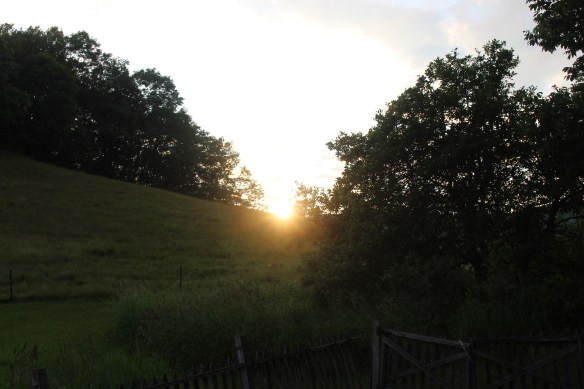
The sun’s light in the back fields of the Accidental Country Pastor’s home in Vermont is always a moment to pause and pray, thanking God for the promise of peace that passes all understanding. 

An Iced Coffee Break

In the midst of this hot and humid week as I try so hard to cross off a million and one tasks on my list that seem to be multiplying rather than growing shorter, I’ve decided to do something radical.

I’m taking a break from it all.

And so I sit here sipping my iced coffee, skimming through my journal from a recent clergy conference focused on self-renewal and have something short I want to share with you. Something perhaps you need to reflect on.

Here it goes.

Questioning why things happen will drive you nuts. It’s really all about celebrating how those things have led you to here—right now, this very moment you are in. Can you see God in this moment? For God is right here, right now, in this very moment.

I think I will have that cookie to go with my iced coffee. I’m sure my list of things to do will wait for me.

Blessings and peace.


Salon Theology 101

I love getting my hair cut. Not because it always feels great to have the split ends removed and to have an inch or so trimmed off, giving my hair my bounce and body. (Okay, I am beginning to sound like a commercial for hair products!)images.jpg

I love getting my hair cut because of the conversations I have with my hairdresser—conversations that go beyond what conditioner to use or how to tame frizz. The conversations we have are conversations we all should be having. They are the conversations about life, love and faith. They are conversations about what it is that makes us who we are. Yesterday I had one such conversation with my hairdresser.

As her scissors worked their magic we got to talking about respect, more like the lack of respect we see towards one another. We got to talking about how no one is addressed anymore as Mr. or Mrs. or Miss. Rather first name basis is now a thing for strangers and casual acquaintances alike. We then went on to share experiences in schools and churches where often titles as Dr., Prof., Rev. and Pastor aren’t used much either.

Perhaps that is why I have such a fondness for rural ministry as it seems in such a setting there are still remnants of a time gone by where folks are still addressed as Mr., Mrs., Miss, Dr., and Prof. I recall many times an adult correcting a child that I was not “Donna” but “Pastor Donna.” At first I was surprised at the correction as I have never seen that happen till serving a little rural church in upstate New York. It was refreshing. But lately, we got to wondering what happened to the use of such identifiers.

Now this conversation wasn’t a gripe session. Far from it. This conversation was more in line of two people trying to make sense of the horrific violence in our world without having to speak of such violence, because how much more can our broken hearts take by once again trying to discern the shootings that have taken more black lives. Yes, I am making the point that these men were of color. Because if we just say “lives” and if we argue against the “Black Lives Matter” slogan, stating that “ALL” lives matter, then we are not being realistic as to how great the problem of race still is in our country. We are fooling ourselves in thinking we have nothing to do with it.

I don’t know. Maybe it was easier for us to speak in code and focus on the umbrella topic of “respect” then having to really dive deeply into the ugly, harsh realities of our world. But maybe we have to dive deep into the muck before we can even think about bopping our heads up to the safe, serene surface we so desperately seek.

It was then my hairdresser said, “How do we expect people to respect one another when we don’t even respect ourselves?”

I had to pause and ponder. She was on to something here. Could it be humanity’s brokenness has gotten to the point where we are lashing out at one another? Could it be the stressors of living are finally making us snap? Could it be we are so unhappy with ourselves that the only way to have some sort of pleasure is to look at another as lesser than and to treat another as lesser than?

I’m not sure. I’m just sharing the thoughts I’m encountering as I dive into the muck, hoping to learn something that will bring me back to the clear, serene surface.

My hairdresser’s words stayed with me much longer than the smooth, blowout I left the salon with. As my hair quickly reverted to its natural state of waves and frizz, I wondered what did God have to say about “respect”?

Remembering a question from my ordination exams long ago which asked about the role of authority, respect, treating one another, etc., I knew to begin my search by turning to 1 Peter. And there it was (the following are excerpts from 1 Peter 2, as presented in The Message):

Make the Master proud of you by being good citizens. Respect the authorities, whatever their level; they are God’s emissaries for keeping order. It is God’s will that by doing good, you might cure the ignorance of the fools who think you’re a danger to society. Treat everyone you meet with dignity. Love your spiritual family. Revere God.

Respect for others.

Respect for self.

Respect in general.

It seems to me that it begins with us first respecting God. It seems to me we need to remember the earliest command in the Mosaic law in which Jesus highlighted beautifully how it is lived out when he told the parable of The Good Samaritan.

It goes something like this:

A lawyer knowing the Mosaic law intimately asks Jesus, “Teacher (notice, the respectful title given to Jesus), what must I do to inherit eternal life?”

And Jesus reminded him of the law, “Love the Lord your God with all your passion and prayer and muscle and intelligence—and love your neighbor as well as you do yourself.”

Notice the “love yourself” thing that is linked to the love your neighbor thing.

But then the lawyer asks, “Who is my neighbor?”

Could it be the lawyer knows he is guilty of not loving everyone? Could it be he is hoping Jesus will say specifically who you can and cannot love and still be good with God?

It’s a good question that I am going to let linger there without an answer. You ponder it. But before you do, first ask yourself the respect question.

For my hairdresser was on to something when she asked, “How can we respect others when we don’t even respect ourselves?”

Well, thanks for entertaining my thoughts for today. I have another hair appointment in six weeks. So stay tuned for more Salon Theology 101.

Postscript

This was written before the news of the shootings in Dallas that have left five police officers dead. Prayers for all who mourn this day. Lord, in your mercy, hear our prayer.


Into the Deep End of Gladness

The place God calls you to is the place where your deep gladness and the world’s deep hunger meet.

Frederick Buechner

Not sure why I wrote this quote in my journal. It wasn’t as if I’ve never heard it before. I had. Many times over. There I was, though, scribbling it down as if the words were brand-spanking new to ears I thought were deaf by now to such pithy quotes. The longer you’re in ministry the longer the list of these quotes seems to get.

I scribbled and reread it. Then I underlined “deep gladness” and read it some more. Next, I circled “deep hunger” and read it yet again. Then “God,” “call,” “meet.” The words were taking on an exciting new life. The speaker at the clergy conference I was attending continued as I gazed down at the fresh ink marks made on the soft gray lines of the bright white journal paper.

“If you don’t know where your deep gladness is—find it,” he commanded, emphasizing “find it” with enough power and punch to get his point across.

It was then my pen jumped at his command and began dancing across the page of my journal. Like the Bible story about the writing on the wall mysteriously appearing in the courts before King Belshazzar that mesmerized me as a child I, too, looked at the words before me wanting to know what they meant, for it was a message I didn’t quite understand or, better yet, didn’t trust to be true.

The mysterious words were, “I do know.”

Really? I do know where my deep gladness has the ability of meeting the world’s hunger?

I thought some more about the divine message that I could no longer ignore—or even erase from my journal. Darn. I knew I should have written this down in pencil! But the truth was let loose.

I did know where my deep gladness was. I knew, but some where and some how I had let life get in the way. How strange it is that the things we need to do in order to “live” are often the very things robbing us of deep gladness? If only we were more aware of that which makes the heart leap for joy would we then start seeing God’s kingdom becoming a beautiful reality in our midst.

This is especially true of our faith communities where, in sacred spaces and on holy ground, time and energy is spent trying to solve the problems of low attendance and little money. Focus on what is thought to give new life, though, actually thwarts the new life Jesus is offering. What is all too soon forgotten is revival begins first by reconnecting with one’s deep gladness. And this deep gladness is always accompanied with the gifts, talents, resources, energy, etc., needed to satiate a hungering world.

Yes, the place God calls you to is the place where your deep gladness and the world’s deep hunger meet. Find that deep gladness now, for the world is indeed hungering.

IMG_0488.jpg

Deep gladness is found out in God’s big backyard where the accidental country pastor’s passion for rural ministry meets the hungering needs of small churches.

Hot Coco, Cherry Jam and Bread

Aunt Sofie is not expected to make it through the night.

It’s strange how a few words spoken in just seconds have the ability to linger in your heart. But linger they do. Just as the smoky residue from the burnt bacon I attempted to cook for breakfast that morning continues choking my lungs, I can’t stop this sadness within from suffocating me.

I am sad for my father’s older sister that her time has come to close her eyes to the beauty of the Swiss Alps she had called home for more than eight decades. I am sad to think she will no longer pick cherries from the trees I once helped her pick from when I was child visiting my dad’s family in Switzerland.

Nothing tasted as good as the tartness of her jam spread abundantly on thick, crusty bread served up with a side of hot coco. Even in the summer hot chocolate was the drink served to us kids, and this wasn’t the packets of Swiss Miss I was used to. This hot coco was the real deal, made with milk from the herd of Brown Swiss who munched on grass and wildflowers in the field. As the drink cooled, the milk would curdle on top creating a slippery film of creamy sweetness you could peel off and eat.images

If you really wanted to fit into the Swiss side of the family, you would dunk the crusty bread into the chocolate elixir, allowing it to get soaked just enough to make it moist yet not to the point where it would fall into the bottom of your mug. The “who can dunk the bread the longest into the hot coco without having it disintegrate into pieces” became a game for my brother and sister and I that summer.

I pick up the roll on my lunch plate. I dunk it into my tepid coffee. Kerplunk. Game over. I had once again dunked too long. I stare into the mug. I can’t breathe. I am suffocating. Suffocating with sadness over the loss of my Aunt Sofie and what it represents.

Her death is not just the passing of yet another one of my father’s many siblings. Her death widens the ever-growing gap between me and my Swiss heritage and adds to a worry I have held since my teen years—what will happen to my connection to family when my father is gone? I never was good at mastering languages and so my meager attempt at learning the Swiss German dialect spoken by my family failed many years ago. And so I am sad about losing a family that I have never really known except through the all too few visits made and the all too few stories my dad has shared with me.

Whether we like them or not, family is important. Family gives us a sense of belonging and an understanding of who we are. As I get older I have come to respect that truth. I have also come to understand why it is that Vermont is and will forever be home to me. For whenever I see the clouds hanging low over the hills and valleys, whenever I hear the cows moo, whenever I hike high into the Green Mountains, whenever I pick cherries or strawberries, whenever I wake up to the early autumn surprise of seeing snow sprinkled on the top of the mountains like powdered sugar on a donut, I feel a powerful sense of belonging and I feel connected to those whose eyes are the same blue as mine.

We will never truly understand who we are, where home is or what makes our hearts come alive with great joy, until we come to know those we are a part of.

And so as each elderly aunt and uncle closes their eyes to the Alps before them, I feel the urgency all the more to keep my eyes opened, to see the many blessings of family before me and to surround myself with that which says “home.”

I feel the responsibility to preserve legacies—even if the legacy is simply the game of dunking bread slathered with cherry jam into a cup of hot coco. It’s something. It’s a start.


The Hallowed Halls of ‘Back Then’

It’s a humid and gloomy afternoon. The kind of afternoon in which you just want to sleep away, but I don’t dare pull the covers over my head. I have a sermon to write, to which I’m failing miserably at.

It seems my mind has a mind of its own. It doesn’t want to help me out in coming up with any eloquent prose on the significance of Jesus casting out many demons plaguing a man.I keep wondering why Jesus just didn’t vanquish the demons? Instead, he relocated them to live in a bunch of unsuspecting pigs who were, up to that point, enjoying life—as much as a pig can enjoy life before becoming a slab of bacon.

Can I really write a sermon sympathizing with the pigs? Probably not. I do love bacon. So I say to my mind, “Take me where you want to go.” It does so happily, taking me away from the here and now and into the hallowed halls of “back then,” where memories have the power to either sadden or gladden. I anticipate both happening. For the back then I go to is a country wedding taking place in a little white church five years ago this week.

I can see the sun shining brightly behind the soaring white steeple. Its rays have chased away all of the drizzle-filled clouds that had me, the bride-to-be, biting my manicured nails.

I can see the sanctuary graced with flowers from the gardens of all the dear women who insisted that flowers were needed in each of the windowsills of the old church. Right before the organ begins the first notes to the bridal procession, I smile with approval at one of the white-haired ladies smiling back at me.

This was one occasion I was glad she didn’t listen to me when I said we didn’t need flowers in the sanctuary. We did need them. I needed them. For they weren’t flowers bought from a florist, arranged in a stiff, artificial way. They were flowers collected with love from local fields and hills and gardens, gathered in bunches and placed in vases that have been hanging around the church for countless years. I bet those vases were happy to be out of the cupboards and once again part of a memory-making day.

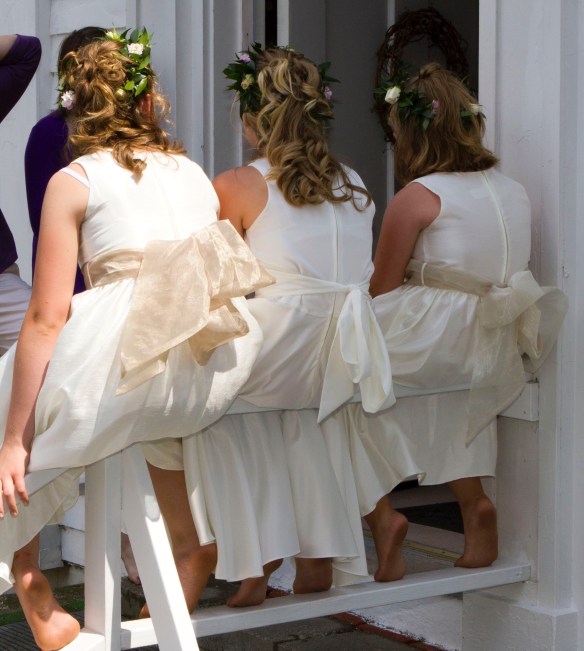
I can see the many flower girls. They are a picture of perfection with their floral wreaths in their hair and their cream colored dresses tied with champagne-colored sashes. Perfection is fleeting though. Soon shoes come off, sashes untie and floral wreaths wilt as the girls play outside on the church lawn. In these hallowed halls of “back then” I spot a picture and stop and stare. Some of the girls are sitting on the wooden rail, with dirty bare feet telling of one fun afternoon. There’s that gladness mixed with sadness, as time has turned these girls into young ladies. That means, I too, have grown older.

I can see the tables in fellowship hall filled with homemade treats that would put to shame feasts typical at an Amish barn raising. I can see my mom and dad beaming with joy. I can see my husband’s parents smiling, with a tear or two. I can see the family of faith gathered who that day became more of a family than I had ever realized. I can see my sister and my new teenage daughter standing together as bridesmaids, bonding over all the stress I put them through in finding the right shade of antique pink for their dresses. And I can see the man God had waiting for me through all those years of heartache and loneliness. There he is standing at the front of the church, my friend, my partner, my love, waiting to begin life together.

I can see it all. And if I allow myself to enter more deeply into the hallowed halls of “back then,” I don’t only see. I can smell those flowers collected with lots of love. I can hear the flower girls laughing on the lawn of the church. I can feel my father’s hand as I grabbed it tightly to walk down the aisle with him. I can taste the rich vanilla in the wedding cake baked by a friend from a neighboring church. I can feel the hugs of all those who have journeyed with me. I can hear God whispering a promise I had often been deaf to.

I am with you…always.

I drift back to the gloomy here and now. I am gladdened and saddened. Where have the five years gone? I wonder about decisions made. Things I could have done differently and should have done differently. Words that should have been said and should have never been said. Dreams still being dreamed and hopes still being hoped. Home still waiting to wrap its arms around me and my husband.

My mind is not quite ready to focus on Jesus, demons or pigs, so I linger a bit more in the hallowed halls of back then, realizing I do so not to live in the past. I do so in order to gain strength for the future, to remember God who has done so much for me is not yet done with me. It’s to help me hear God’s whispered promise of being with me that I need to hear especially on these gloomy here and now kind of days.

flowergirls

A picture from the hallowed halls of “back then”…a country wedding in a little white church, where flower girls played all afternoon on the church lawn.


After 2 A.M.

Nothing good ever happens after 2 a.m.

The song’s lyrics on the radio leaped out at me. “That singer is right,” I said to my husband, whose eyes were fixated on the road leading us back home to the slumbering bucolic hills and valleys of Vermont. “Nothing good ever happens after 2 a.m.”

My husband looked at me strangely, wondering where I’ve been that I had never heard what turned out to be a popular old saying that he knew quite well.

Less than 48 hours later, the saying I had just become acquainted with had sadly been verified. The news broke a peaceful Sunday morning into a million shattering sharp pieces.

2:09 a.m.—A man armed with an assault rifle entered an Orlando night club. Shots fired. 50 reported dead. 50 more injured.

Nope, nothing good ever happens after 2 a.m. Or for that matter, nothing good happens at 9:30 a.m. as we saw in an elementary school in Connecticut; or 9:25 p.m. when news of shooting in Parisian restaurant came our way; or 8 p.m. when we learned of the carnage happening at a Bible study in a Charleston, S.C. church.

I don’t need to go on any further because I’ve made my point. And, anyway, I have to stop for my stomach is getting queasy and my eyes are filling with familiar tears that I have cried one too many times in one too many cases for one too many senseless killings. Nothing good ever happens…at any given time these days, so it seems.

Shortly after news of Orlando seeped into our quiet Sundays, I read a posting on social media blasting the lack of outcry over the lives lost in the dreadful after 2 a.m. hours of the morning. The person cried that the lack of attention given was because those gathered were gathered in a gay nightclub. I’m not discounting that there is some truth to that. But I did disagree with this person because perhaps the lack of outcry was not due to sexual orientation.

Perhaps many were not being vocal because such news has become all too common. Dare I say that we are slowly becoming desensitized to it all. Yes, there is a feeling of anger, of outrage, of fear, of sadness, of confusion. In the midst of all these emotions, though, no one has really addressed or unpacked the most dangerous of all emotions: helplessness, which leads to the No. 1 killer of hope in the world—complacency. And so, silence begins to happen as we sit and wonder, “What can I really do?” and “Does my voice even matter?”

As I skimmed the reactions on social media, I found myself getting perturbed at the postings calling for “prayer for the victims.” And I, a pastor, cringed at the news of prayer vigils popping up all over the place. It’s not that I’m against prayer nor has all of this violence in the world turned me into an atheist.

Prayer can and will change all circumstances. Prayer is not something we turn to only AFTER a tragedy strikes.

Where are the prayers that need to be said for a broken world before the brokenness decides to rear its ugly head in some catastrophic way?

Where are the weekly gatherings in which God’s children listen to the whispers of holy instructions that speak of loving one another and forgiving completely?

Where is our commitment to pray to God for help, wisdom and the strength to be the blessed peacemakers in this world?

Where are the prayer circles that gather before tragedy strikes, thus, making prayer vigils obsolete?

Every Sunday night a dedicated few would gather for prayer in the chapel of the little white church I served. There we would sit. In the heat of summer, the door would be open allowing a breeze to blow through along with the black flies. In the cold of winter, we would keep our coats on for we wanted to be good stewards of the building and keep the church’s heating costs down.

Sometimes we just sat awkwardly in silence. Sometimes we named a concern. Sometimes we prayed for others. Sometimes we even prayed for ourselves. But all the time, no matter what was said or not said, we left renewed with hope. We left in awe with gift of feeling the presence of God.

Did these prayer circles change our church? Yes, they did.

Did they change the community? I think so.

Did they change the world? Some people would say no, they didn’t. But they changed each one who attended. And that change, no matter how insignificant it might seem, is the change that will ultimately change the world. One person, one heart, one prayer at a time, that’s how a seemingly invisible God becomes visible to others.

And that’s where we have to start. Because nothing good ever happens after 2 a.m.—or 9:30 a.m. or 9:25 p.m. or 8 p.m. There’s a world growing darker with hate. Tragedies will occur anytime, anywhere. We, though, don’t have to let helplessness turn into complacency. We have a choice.

We can continue to gather in prayer vigils after the darkness has covered us, or we can turn to God before our times of trouble. We can pray, encircled together, for love to win and for peace to shine brighter than any darkness.

It’s time for more prayer circles and fewer prayer vigils.

Blessed be those who mourn this day, for they will be comforted. Matthew 5:4

IMG_5271

The “little white church” where Sunday prayer circles did have the power to change the world—opening one heart to God’s Spirit at a time. 

Standing Together


It was a timed honored tradition in the little rural village. Every Memorial Day the clergy would gather in front of the old courthouse that was now transformed into a community center. Stories from old timers spoke of how every once in awhile someone locked up imgres.jpgbehind the bars in the courthouse would break out and hide in the cornfields surrounding the building, as well as the cornfields surrounding the school. Perhaps that is why the courthouse was eventually moved out of the village and into a more populated area where cornfields didn’t exist.

Every Memorial Day clergy, including myself—an accidental country pastor—would gather in front of that courthouse. We would gather with the high school band. We would gather with the Boy Scouts. We would gather with families, young and old, who came out for this timed honored tradition. We would gather with the veterans still able to gather, to remember those who died in service to our country. We would gather, then march throughout the village to each war monument, where we would stop, say a prayer, lay a wreath in front of it and listen to the gun salute.

Our march would then continue to the Revolutionary War cemetery and then into cars we would go, heading up the road out of the village to the cemetery where many a Civil War soldier rested. Back into cars and off to our last stop—the cemetery just up the other road out of the village that belonged to the Catholic church. Father Condon, a staple in the village almost as time honored as the Memorial Day march itself, would be waiting there ready to deliver the last prayer of thanks and remembrance in his thick Irish brogue.

There on the outskirts of the village, with the first signs of corn breaking through the ground beyond the cemetery, with the views of rolling green hills and mountains, with the warm breeze blowing the scent of freshly mowed fields, I observed something that would forever change my view of Memorial Day.

I observed community at its best, taking time not to use Memorial Day as a kick-off to the unofficial start of summer, but staying true to the observance of those who gave their lives so that they could have life as they know it in their little rural village.

You see it didn’t matter what differences we had or who was having a spat with whom or who held a 30-plus year grudge against so-and-so. What mattered was for at least one morning in late May we were remembering not only the costly gift of freedom. We were once again renewing an unspoken vow to stand together in community.

As a pastor I just wasn’t there to pray. I was given the privilege to stand with the community by standing by the sides of those veterans who were tasked with the responsibility of laying the wreaths.

I will forever remember the startling feeling of honor that came over me the first time I took the gnarled hand of one veteran. I actually didn’t take his hand. It was more he had to reach out and grab mine to regain a step that wasn’t as steady as he thought it would be. I caught his hand and we continued to walk. With each step we took, I could feel his hand needing to hold on tighter to mine. Each faltering and hesitant step was caught and made more secure as I gripped tighter and leaned in closer and whispered, “I’m standing by you.” And with that reassurance, I noticed his back hunched over with age straightened just a bit and a smile of many thanks graced a face etched with golden and not so golden memories.

It was then I began my own time honored tradition of making sure each time I walked with a veteran to lay a wreath at a memorial, I would take their hand, lovingly squeeze it and remind them of something we would all love to be reminded of no matter what our age.

“I’m standing by you.”

That little rural village showed me the beauty of Memorial Day that I had never seen before nor ever since.  I saw a community putting aside all the things they had the freedom to do on a Monday off, so that they could stand together with those who stood up to the evils of war so many years before. I also saw future generations learning that even in times of peace, standing together should never end.

Who have you stood by today? Have you held the hand of someone who needs support to make their steps steady? Do you realize no matter where community might be—in a church, a civic group, a village, a town, a family, a school—it can only happen when we make the commitment to be there for one another and to stand together.


The Ground Beneath Our Feet

It was early morning and as I laced up my sneakers I could hear my husband’s question coming from the kitchen.

“Where’re you going?”

“Out for a walk. Do you want to come?” I asked.

Sofie, the Bernese Mountain dog who had already begun panting from the heat building up, looked at me horrified as if to say, “Please mommy, don’t take mimages.jpge out in that humidity. My fur will frizz just as badly as your hair!”

With a pat on her head, I reassured her she could stay in front of the air conditioner. I would deal with my hair by throwing it up into a ponytail. Again, I asked the question. My husband sided with the panting dog.

“Okay. I’ll be back when I’m back.”

And with that, out the door I went.

Walking had always been a time for me to clear my head, lighten my burden, slow myself down and talk to God. Lately, though, I’ve noticed my walks haven’t been all that prayerful.

Was it the oppressive humidity that comes with living below the Mason Dixon line? Was it now having to walk busy suburban roads rather than the rural ones I had fallen in love with while serving as an accidental country pastor? Or was it because I had unwittingly invited a long lost, toxic friend to join me on my walks?

Yes, somewhere along the way I had welcomed back Miss Rushed And Frazzled—the part of me that takes away any peace that does exist. The part of me who plays a narrative in my head of all the things that need to get done and keeps on playing it like some one-hit wonder on my playlist that I can’t seem to delete.

Admittedly, there was a time when my walks were anything but prayerful. There was a time when I couldn’t even feel the ground beneath me because I was so caught up in clutter. Hmmm? Clutter? What exactly is the definition of that word? That’s right. Clutter—to fill with too many things. My life was filled with too many things and it was destroying the who God wanted me to be.

Then one sweltering summer afternoon, where the exhaust from the New York City buses mingled with perspiration from people packed onto the sidewalks like sardines, all that clutter fell away.

It was on the corner of 32nd Street and Park Avenue that I, for the first time in my life, felt the ground beneath my feet.

It was there my fast-paced walk came to an abrupt halt when a boyfriend, walking by my side, dared to stop mid-step. Before I could ask why, the boyfriend pointed to our shadows and held them with his eyes as if he was gazing upon a Paul Klee we had just seen earlier that day at the Metropolitan Art Museum.

“Look,” he said, embracing a beauty I was blind to—just as I was to the Paul Klee earlier that day. Personally, I prefer the folksy charm of Grandma Moses. But I digress.

I guess my obligatory, less than a second look didn’t convince him that I was in the moment with him. He insisted again that I look. I did my best, but I just couldn’t see what he was seeing. He was noticing us in a moment of time on a city sidewalk. And he took the time to honor that moment as if it was sacred.

There we were, standing still as a silent liturgy lifted to heaven as the city rushed on without us. A squeeze of my hand signaled to me the sacred moment was over and we could begin walking again. I noticed, though, I was pulling him along as his steps were still so slow and mindful.

“Now what?” I asked with as much patience I could muster. He stopped again.

“You don’t get it,” he said with sad puppy dog eyes.

No, I didn’t. And he was more than willing to fill me in on what I was missing.

It seems I was missing what a privilege it was for me to be able to walk. I was missing what it meant to actually feel the hard pavement underneath my feet and to be thankful for the shoes I had that protected my feet from the scorching heat of the pavement. I was missing that fact that each step taken in my life was a gift leading to something beautiful.

A step taken leads to a cool drink. A step taken leads to arms waiting to embrace us. A step taken leads to hearing a new voice, seeing a new place, experiencing a new experience. Without steps taken forward, you wind up nowhere. I was able to those steps. Be thankful for that, he said.

I didn’t understand, too, that life was like our shadows on the sidewalk, begging for us to notice and savor the moment we are in, for that moment will never be again. I didn’t get it. But he did.

He had spent time in the Peace Corps teaching English to children in Africa. It was there he began noticing for the first time the ground beneath his feet. He noticed how others didn’t have the ability to walk as he did. He noticed how others didn’t have shoes to protect their feet from the sun soaked, drought ridden ground. And it was there in Africa he stopped to marvel at the beauty of his shadow on the earth, for far too many of those children he taught would not have shadows to marvel at as their life was shortened by strife, poverty, war and hunger.

“Do you realize what a gift we have right now?” he asked, looking down at his feet. I stood there speechless. I never knew there was so much to be seen, experienced and celebrated in each step I took. I looked down and stared at my feet on the ground beneath me.

A squeeze of my hand nudged me to begin walking again. Right foot, left foot. My shadow walked with me—and I noticed.

Right foot, left foot. I noticed the pounding of the pavement on the sole of my shoe.

Right foot, left foot. I noticed the gift I had been given. I noticed the gifts that were waiting ahead of me.

Right foot, left foot. My steps were different. My steps were prayerful.

Now, many years later I stand on a noisy suburban road. I find myself stopping again. I need to notice my shadow. I need to marvel at the sacredness of the moment I am in, for aren’t all moments we have sacred?

I drink in the heavy morning air scented with car exhaust from the busy road near the house my husband and I rent, not as fresh as the air in our home in Vermont but at least not as pungent as the air that summer afternoon in Manhattan. It is air nevertheless that fills my lungs and for that I thank God.

Right foot, left foot. I am walking—prayerfully again.

Right foot, left foot. I am walking—with God again.

Right foot, left foot. I feel the ground beneath my feet—again.

Right foot. Left foot. I know each step forward will lead to something beautiful—again.

Rocking Chairs

Drive in circles. Round and round. Airport’s long-term parking lot finally found. Park the car. Write down the parking space number so that I will remember where my car is upon my trip back. Hop on the shuttle bus to the terminal. Hop off the shuttle bus. Weave my way through the long lines. Check in. Check bag. Check. It’s done.

Now take off shoes, take out laptop, turn on cell phone, place in bins. Go through airport security. Put shoes back on. Double check that all my belongings are out of the bins and are once again in my possession. Find some coffee. Rush off to gate.

Almost there…almost there.

Pick up pace. Time is ticking. Mind is racing. Nothing noteworthy to share. Just racing with mindless clutter. Pace picks up, time ticks on, mind continues racing…faster, faster.

Almost there…yes, almost there.

Slam on brakes. Screeching halt. What is this? images

Rocking chairs. The kind you would find on an old farmhouse porch; not in an airport terminal. But there they are. Rocking chairs lined up in a row begging for busy travelers to stop and rest. There they are. Lined up in a row—empty.

Rocking chairs. The kind that makes me remember a simpler way of life that a family of faith in a little white church invited me to be part of years ago.

The kind I remember sitting in while sipping a root beer float well-renowned in the village and beyond, lovingly made by the elderly hands of a farmer’s wife/potter/artist/one amazing woman.

The kind in which I ate melting ice cream over a just-out-of-the-oven berry cobbler.

The kind in which I heard stories of the years when crops were good and the years they were not so good.

The kind in which a long-retired farmer and I would simply sit and listen to the rustling of cornstalks in the hot summer wind.

The kind that invited confession as painful secrets were shared. The kind that granted assurance of pardon as old misunderstandings were rocked away.

The kind I would sit in every night on my very own country porch listening to peepers and watching fireflies light up the sky. The kind I would sit in crying my tears to God. The kind I would sit in singing my praises to God. The kind I would sit in wondering how it was that God led me to this way of life—to my heart’s desire.

Rocking chairs in an airport. Empty.

They’re preaching an important message, but the message is falling on the deaf ears of travelers only concerned with getting to their next “almost there.” But no one seems to stop long enough to look around and ask, “Where exactly is the ‘there’ I’m going to?”

I hear the message, though. I hear it loud and clearly.

Time IS ticking. Slow your pace and ease your mind.

The rocking chair beckons. I sit and I rock. The movement is soothing. My rushed breathing slows. I close my eyes.

Peace that has been missing like a suitcase stuck in some proverbial airport baggage purgatory, reclaims its owner. Peace reclaims me.

Back and forth I rock.

All of a sudden I am sipping that famous root beer float. I taste the berry cobbler once again. I know exactly where those berries were hand-picked. I was there. I have the berry stained shirt still. I hear now the rustling of the cornstalks drowning out the airport noise around me. I see the weathered face of that dear long-retired farmer. I notice his cataract-clouded eyes gazing longingly for glimpses of days gone by. I join him in that search.

I search. I rock.

I rock. I search.

The rocking chair’s sermon is being preached.

Time IS ticking. Slow your pace and ease your mind. Almost there. Yes, almost to the ‘there’ I want to be.

It’s the place where my shattered heart was lovingly pieced together by a precious gift called God’s grace. It’s the place where my steps began to move in sync with that of the Holy Spirit. It’s the place where divine fellowship was shared in the guise of a root beer float and berry cobbler. It’s the place where a rocking chair on a country porch waits for me to come home to. For me to sit and pray awhile.