Living Water

There’s a marshy piece of land behind our little red house that is overgrown with tall grass, burdocks and goldenrod. On occasion a wildflower—or two—will peek its pretty head out from the overgrown tundra that has become its unexpected home, thanks to a bird dropping a seed en route in its flight south for the winter. Mostly, though, this marshy piece of land is made up of tall grass and weeds.

When my husband and I first moved in, we tried mowing this area so it would blend into the surrounding landscape. It was not to be. Even in the driest of dry spells the mower would sink down into the still wet and muddy earth beneath.

“It’s just useless,” my husband would say, noting the look of disappointment on my face.

“Really? Perhaps I can try?” I offered.

A look of fear washed over his face. I knew what he was thinking. He would come home one evening from work to find his wife and his beloved riding mower sinking quickly into the marsh. I tried my best to assure him I wouldn’t do anything stupid, at least, not attempt anything stupid when he wasn’t home to help rescue me—and his mower.

Still I was not ready to give up on my vision of an unmarred rural New England landscape, one that would rival those pictured in a Country Curtains catalog.

As a teen I would bypass all those teen-cult magazines talking about how to zap a pimple or get a cute guy to notice you. My reading pleasure was a Country Curtains catalog. I would stare longingly at the pastoral views that were pictured beyond the multi-paned windows draped with material hanging on rods. I wondered what it would be like to live with views like that? (I now wonder now how many curtains did I buy from that catalog all due to my intoxication with the view and not the curtains per se?)

I no longer had to wonder. Each window from our little red house looked out upon rolling hills, cornfields and the green mountains of Vermont. And everyday, no matter how the day was going, whenever I looked out the windows, I smiled and thought, “Wow. I have my very own Country Curtain views.”

All except for that darn piece of marshy land right in back of our house. It was an eyesore to me.

My husband suggested we could turn it into a pond. Perhaps. But until then, every time I sat on the back porch there it was right before me—tall grass and weeds blowing in the wind with only the occasional pretty wildflower—or two if I was lucky—peeking out to cheer me up. I soon began to wonder why was that little piece of land always so wet?

One day as I took our bumbling Bernese mountain dog, Sofie, for a walk on our sprawling five acres, I got my answer. There up a ways from the marshy piece of land was a tiny steady stream of water flowing and feeding down into the weeds and tall grass. I walked along the stream of flowing water trying to find its source. Was there a larger stream? A pond somewhere I didn’t know about? A brook? I kept walking…and walking…and walking. I found no such bodies of water that were feeding this steady stream that nurtured my marshy piece of land. Perhaps there was an underground spring of sorts.

It was time to turn back to the house as the sun was beginning to set. And so we walked, me with my feet on dry ground and Sofie, of course, with her paws happily prancing in the tiny stream of flowing water.

As we got closer to the little red house, I saw something I had never seen before. There in front of me was the most beautiful tall grass blowing in the wind. There in front of me were these goldenrods made ever more golden by the sun’s setting rays. There before me was not a marshy eyesore I so badly wanted to get rid of. There before me was something beautiful created by living water coming from an unknown source feeding the grass, the burdocks, the weeds, and yes, even the occasional wildflower—or two.

Jesus talked many times about offering us living water—water that quenches what is dry and parched and brings life and hope back. Living water was a metaphor those in Jesus’ day would understand for out in the wilderness, after the much needed rains would come, water would be “alive” flowing on its own power bringing the relief those who were thirsty needed. The flowing water was viewed as powerful, mystical, sacred…and beautiful.

We all need living water. Water that not only quenches are deepest physical thirst, but living water that flows in our lives with a mighty God power, carrying us and leading us to all that is lush and all that is truly beautiful.

I looked down at Sofie still with her paws in the living water we had just discovered on our property, when all of sudden she assumed a hunting position with nose pointed forward, one front paw extended with one of her hind legs reaching back the other direction. I held more tightly onto her leash so she couldn’t lunge forward to get the beautiful red winged blackbird that swooped in and landed on top of the tallest pieces of grass swaying in the marshy piece of land that I had once thought was an eyesore. It was no longer that. I now saw it for what it really was. It was a sanctuary for God’s creatures—a sanctuary created by living water.

Life can’t be an unmarred pastoral landscape. We try to create such, but it just can’t be. Life needs a marshy piece of land with weeds and tall grass and burdocks and goldenrod and that occasional wildflower or two. A place touched by the power of living water which then becomes a blessing to those all around.

And so the marshy land still stands behind our little red house looking prettier than any Country Curtains view I could have ever hoped for.

It stands as a testimony not only to the power of living water on our property. It stands as a testimony of the living water I know that flows in my life, the only thing I need when my soul is parched.
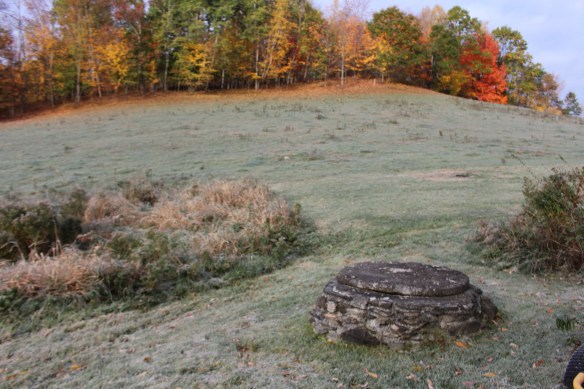
IMG_1259

The marshy piece of land, fed by the living water on our property, sits to the left beyond our old stonewall. It’s no longer an eyesore, but a beautiful sanctuary for tall grass, burdocks, goldenrod, the occasional wildflower or two, and yes, even weeds. And the birds love sitting on top of the high grass.

Peeling Paint

Should I or shouldn’t I? I mean, really, what’s the worst thing that could happen if I climbed this rickety ladder? Maybe I shouldn’t have asked that question because my mind suddenly started to answer with many a scary scenario.

I could fall. I could seriously hurt myself in the fall. I wouldn’t be able to call for help, as there was no cell signal in this part of Vermont in which our little red house sat sweetly in a valley surrounded by fields and views of the Green Mountains. I would be alone and hurt with no help coming anytime soon as my husband had not yet joined me for our visit to our little homestead. I would be left there on the grass risking the chance of a garter snake slithering upon me.

Eeek. Garter snakes. I don’t like them. My mom and dad recently reported that on one of their visits to our little red house they saw a “huge” one slithering underneath the apple tree. Of course, the snake grew larger as their story continued. Still, I wouldn’t want to risk meeting said snake no matter how small or large it was.

Maybe I would be okay if I climbed this ladder. There was, after all, my bumbling Bernese Mountain dog, Sofie. But as I looked over at her hugging the side of the fence as a sudden wind had picked up and frightened her, I realized she was no Lassie. I was on my own. And so I asked myself again, “Should I or shouldn’t I?”

What’s the worst thing that could happen if I decided to climb this rickety ladder I had just wrangled out of the damp, stone cellar, and set before me on the uneven ground below me, all because I couldn’t live one more minute with what my husband could live with forever?

I just couldn’t live with the strips of paint peeling from the beaten-up-by-too-many-harsh-winters clapboards that sided our home. Something had to be done.

I grabbed hold of the ladder with one hand and hesitantly put my foot onto the first rung. My heart started thumping harder. Up onto the next rung my foot went. Then the next and then the…wait, I had forgotten something. I had forgotten the can of paint and paintbrush. Back down I went and grabbed the necessary items needed for painting, wondering all the while how was I to hold on to dear life…and the ladder…and the paint can and the brush?

As one who loves to take on the challenge of a “can’t be done” project, I fought my fears and went back up the ladder, balancing each step I took with the can and brush in one hand while the other hand grabbed the next rung.

I finally came to the first patch of peeling paint and leaned over to scrape it off. As I leaned I made the mistake of looking down. Our little house didn’t look that tall but from where I was, “down” looked like a very long way to go. Sweat came dripping down my forehead as I whispered: “Hold it together.” “Breathe.” “Don’t think about it.” “I can do this.” I scraped quickly and then threw the paint over the bare spot. My sense of accomplishment was short lived for I realized while one piece of peeling paint was dealt with, there were many more taunting me further up the house.

It was then I had to ask myself the very question my husband asked while trying to persuade me to leave the ladder where he had put it—in the cellar.

Why does the peeling paint bother me so much?

Peeling paint exposes more than weathered clapboards; a lesson of the heart is revealed as well.

Peeling paint exposes more than weathered clapboards; a lesson of the heart is revealed as well.

The most obvious answer was simply because peeling paint was an eyesore and made the house look shabby. What would those passing by think? To which my husband would reply, “No one cares.”

But there was more going on than just what would the neighbors think. In some way the peeling paint was symbolic of everything I was taught you had to fix or cover up in life. Now my parents, who had more of my husband’s “no cares” attitude, didn’t teach me this.

This need to be perfect or have your act together or at least appear to have your act together was instilled in me during my days as an aspiring Manhattan magazine editor. It was there in the city in which Sinatra sang, “if you can make it there, you’ll make it anywhere,” I saw firsthand how life’s disappointments, hurts, flaws, and even painful scars, were all too easily—and expected to be—painted over with whatever paint you could find. Lonely? Paint over it by working longer and harder. Heartbroken? Paint over it by rushing into a new relationship quickly. Don’t give the brokenness anytime to heal. Dissatisfied with yourself? Paint on a new persona, workout more, buy new clothes, and get a makeover. Do whatever you can to cover up the peeling parts of your life because you don’t want the world to see the weather-beaten clapboards that are hidden underneath in your heart. For it is more than just an eyesore. It is a reminder of our own finitude and vulnerability. And no one wants to be reminded of that. So let there be no peeling paint in life—ever.

Yet here I was with peeling paint and a husband who just didn’t seem bothered by it at all.

His “no one cares” attitude was strengthened by his other observation. “Everyone around here lives with peeling paint,” he said. And they do.

I remember when I first came up north to “God’s Country” as the locals called it, I noticed many a house, many a barn—and even the picturesque white clapboard church I was to pastor—telling the story of how they had withstood yet another season of howling winds, pelting rain and falling snow. I was told with a shrug of the shoulders, “That’s just life around here. Paint will peel. Nothing much you can do about it except live with it.”

There wasn’t an urgent need to cover up what tough seasons had scarred, be it the tough seasons of Mother Nature herself or the tough seasons that barrel down on us in our life—illness, fractured relationships, financial worries, death.

If anything, the peeling paint on display all around me in so many ways provided the space to face finitude and vulnerability without dread or fear or the feeling of failure or hopelessness. The peeling paint was in fact a shared communal experience no one judged, but rather, was understood by all. It was simply a part of life not to be covered up. It was a part of life to accept, embrace and learn to live with. And the learning to live with? Well, that’s when an eyesore miraculously becomes something beautiful and amidst the newly discovered beauty before you is where healing begins.

As I stared at the marred side of my Vermont homestead, I saw the beauty before me and in that beauty I realized something. It was here in a place where paint peels freely, the weathered clapboards of my own heart were accepted and welcomed and loved by a community which knew the truth so many of us try to deny. In life, paint will indeed peel. There really is no need to rush and cover it up.