Standing Together


It was a timed honored tradition in the little rural village. Every Memorial Day the clergy would gather in front of the old courthouse that was now transformed into a community center. Stories from old timers spoke of how every once in awhile someone locked up imgres.jpgbehind the bars in the courthouse would break out and hide in the cornfields surrounding the building, as well as the cornfields surrounding the school. Perhaps that is why the courthouse was eventually moved out of the village and into a more populated area where cornfields didn’t exist.

Every Memorial Day clergy, including myself—an accidental country pastor—would gather in front of that courthouse. We would gather with the high school band. We would gather with the Boy Scouts. We would gather with families, young and old, who came out for this timed honored tradition. We would gather with the veterans still able to gather, to remember those who died in service to our country. We would gather, then march throughout the village to each war monument, where we would stop, say a prayer, lay a wreath in front of it and listen to the gun salute.

Our march would then continue to the Revolutionary War cemetery and then into cars we would go, heading up the road out of the village to the cemetery where many a Civil War soldier rested. Back into cars and off to our last stop—the cemetery just up the other road out of the village that belonged to the Catholic church. Father Condon, a staple in the village almost as time honored as the Memorial Day march itself, would be waiting there ready to deliver the last prayer of thanks and remembrance in his thick Irish brogue.

There on the outskirts of the village, with the first signs of corn breaking through the ground beyond the cemetery, with the views of rolling green hills and mountains, with the warm breeze blowing the scent of freshly mowed fields, I observed something that would forever change my view of Memorial Day.

I observed community at its best, taking time not to use Memorial Day as a kick-off to the unofficial start of summer, but staying true to the observance of those who gave their lives so that they could have life as they know it in their little rural village.

You see it didn’t matter what differences we had or who was having a spat with whom or who held a 30-plus year grudge against so-and-so. What mattered was for at least one morning in late May we were remembering not only the costly gift of freedom. We were once again renewing an unspoken vow to stand together in community.

As a pastor I just wasn’t there to pray. I was given the privilege to stand with the community by standing by the sides of those veterans who were tasked with the responsibility of laying the wreaths.

I will forever remember the startling feeling of honor that came over me the first time I took the gnarled hand of one veteran. I actually didn’t take his hand. It was more he had to reach out and grab mine to regain a step that wasn’t as steady as he thought it would be. I caught his hand and we continued to walk. With each step we took, I could feel his hand needing to hold on tighter to mine. Each faltering and hesitant step was caught and made more secure as I gripped tighter and leaned in closer and whispered, “I’m standing by you.” And with that reassurance, I noticed his back hunched over with age straightened just a bit and a smile of many thanks graced a face etched with golden and not so golden memories.

It was then I began my own time honored tradition of making sure each time I walked with a veteran to lay a wreath at a memorial, I would take their hand, lovingly squeeze it and remind them of something we would all love to be reminded of no matter what our age.

“I’m standing by you.”

That little rural village showed me the beauty of Memorial Day that I had never seen before nor ever since.  I saw a community putting aside all the things they had the freedom to do on a Monday off, so that they could stand together with those who stood up to the evils of war so many years before. I also saw future generations learning that even in times of peace, standing together should never end.

Who have you stood by today? Have you held the hand of someone who needs support to make their steps steady? Do you realize no matter where community might be—in a church, a civic group, a village, a town, a family, a school—it can only happen when we make the commitment to be there for one another and to stand together.


Day 7—Hanging the Greens

A Little White Church Advent

Come on an Advent journey and walk the rural roads and snow covered paths with Donna Frischknecht as she shares stories of God’s promises being fulfilled in the most amazing ways. These stories of “Emmanuel”—God with us—were gathered during her time serving as minister in a historic white clapboard church in upstate New York, right on the border of Vermont, from 2007-2013.

December 7

I was told to prepare to be wowed. I was told it was going to be like nothing I have ever seen. I was told it was one of the many things that made the little white church I was serving as pastor special.

Early in Advent the church had a tradition of hanging all the Christmas greenery as part of its worship service. Now I was a bit perplexed when I heard it was part of the actual service. How? When? Where? What? So many questions because I’ve never heard of such a thing before nor have I seen a church get “greened” right before my very eyes.

When I was a child the ivy and holly and poinsettias and Christmas tree always seemed to miraculously appear from one Sunday to the next. In my childlike awe, I just presumed it was Santa’s little elves at work making the church pretty for the season.

Those elves of my childhood seemed to be at work as well at the Fifth Avenue church I worshipped during my time living and working as an editor and reporter in Manhattan. One Sunday the doors were bare and the next, poof! Wreaths appeared from nowhere and greeted you with festive cheer.

Later on when I heeded God’s call to serve in the church, I realized the greening of a church did not involve the magic of Santa’s elves. Rather the decorating was more an adventure of getting volunteers to spare just a few minutes either on an weekday evening or a Sunday after worship to help get the church ready for Christmas. This feeble call for decorators was often helped by the promise of pizza afterwards. Food has a way of bringing out the volunteers.

“No, pastor, we really do decorate the entire church during the first hymn,” was the reply I got back from members of the worship committee when I asked for what might have been the twentieth time as to how this was all going to happen?

I guess my lack of comprehension was amusing for eventually the members of the little white church decided not explain to me anymore about how it would be done. Instead, they gave a knowing smile to one another and then a reassuring smile to me, their pastor, and said, “Don’t worry about a thing. Just wait and see.”

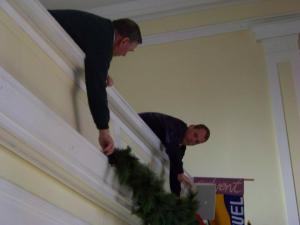
The Sunday came and the hymn to hang the greens by began to play. The tune was the familiar “Angels We Have Heard on High” but the words were completely foreign to me. The words, written many years ago by a member of the church, sang of the meaning behind the greens, talking of God’s love as everlasting—and as evergreen—as the swags being strung from the balconies that wrapped all around the early Colonial sanctuary.

The new verses to the familiar tune continued to be sung. I eventually stopped trying to sing for I just wanted to take in all the magic going on right before my very eyes.

On one side of the balcony there stood the testimony of time as father, son and now grandson stood together to be part of this beloved Christmas tradition. I stared at the three generations working together and realized there before me was a powerful illustration of what handing down the faith was all about—sharing the traditions, the stories and working to glorify God together, side by side. I looked at men and women who all of sudden stood up from their pew with evergreen in their hands ready to wrap the ancient pillars of the church. Even more people came up to where I was standing on the chancel and from behind the ornate wooden pulpit chairs, large wreaths appeared and were hung on either side of the chancel.

841_4121436789937_670928748_n

My husband, PJ, helps hang the greens from the balcony in the little white church the first Christmas we were married.

By the time the last verse was sung—or the first verse repeated if more time was needed to finish the greening—there was not a dry eye or the lack of a beaming smile coming from all in the sanctuary. Everyone looked at one another and at the beauty that surrounded them. Joy filled the air.

There before us, in the greening of the church, was the great Christmas message of how God breaks into our hearts with hope. There before us was the reminder that if God can transform a barren sanctuary into something glorious in just the singing of a song, imagine what God wants to do in our own lives? For one second we might be crying, we might be complaining, we might be walking in what seems to be a never-ending road of darkness, but then in a blink of an eye the promise of God’s everlasting love can—and will—appear. And here was the most important reminder seen in the hanging of the greens that took place as part of the worship service. God often breaks into our lives through the hearts and hands of others. God uses his beloved community to bring about miracles as small as making a little white church ready for Christmas to as big as making those in the world ready for Christ.

I was told to prepare to be wowed. I was told it was going to be like nothing I have ever seen. I was told it was one of the many things that made the little white church I was serving as pastor special. And everything I was told exceeded this pastor’s expectations.

Thanks be to God.