Worship at Old Stone Well Farm
4
By Donna Frischknecht Jackson
I’ve been obsessively counting the days this week till the debut of the “Hamilton” movie. I don’t live in Manhattan anymore, nor do I now live in an area with easy access to the arts of any kind. I am a resident of rural America, meaning any culture in my life takes a lot of planning and travel. Sure, there are museums and way, way, way off Broadway productions that do their best to light up small stages within driving distance, but the distance is a deterrent most of the time.
And so, when I heard “Hamilton” would be in front of my very eyes on my computer screen — no driving two hours or so — I jumped for joy. Broadway at its best and with a dose of 18th century history for this 18th century history lover.

What more could I ask for than a show about Alexander Hamilton, one of the founding fathers of the country?
Funny that I asked that, because “Hamilton” gave me more than I was prepared for. As I counted down the days to the show, I discovered that “Hamilton” wasn’t just going to be a much-needed escape from my crazy world filled with deadlines and church duties. The production was going to open my eyes. It was going to get me thinking. It was going to make me want to jump up and cry out for a new revolution.
You see, as the media blitz leading to the July 3 movie release picked up speed, I took moments to stop my own writing and editing to listen to several Zoom interviews with cast members who, being men and women of color, were providing a startling and unique stage setting for white America’s history. George Washington, Aaron Burr, Eliza Hamilton, the list goes on — played by actors of color. I found it profound and I began feeling something stirring inside of me.
It was then I heard Daveed Diggs, who played Thomas Jefferson and Marquis de Lafayette, speak about his experience performing in “Hamilton.” He talked about how telling the story of the birth of this country has been an awakening leading many to realize that we are in another moment of awakening.
“A lot of people are feeling very passionate about not allowing business as usual to continue, in terms of how we govern ourselves, how we police ourselves, all of these things,” said Diggs in an interview. He continued to say, “I’ve been Black my whole life, so this feeling is not a new one to me. ‘Hamilton’ has an opportunity to help the conversation continue further…”
Maybe some of you remember the “Hamilton” controversy in 2016, when during the curtain call, the cast welcomed in-coming vice president, Mike Pence, with a message that was not mean spirited or condescending but stating a heart-felt fact. The actor who played Aaron Burr that night, Brandon Victor Dixon, said, “We truly hope this show has inspired you to uphold our American values and work on behalf of all of us. All of us. Again, we truly thank you truly for seeing this show, this wonderful American story told by a diverse group of men and women of different colors, creeds and orientations.”
If the opening shot at the Battle of Concord in 1775 was hailed as “the shot heard around the world” which started a revolution, perhaps that brutally honest welcome from Broadway’s Richard Rodgers Theatre was to be another proverbial shot?
That’s when I began pondering. If the patriots of the American Revolution were heavily influenced by a time in history known as the Enlightenment — a time where policies, new ideas, fresh possibilities were entertained, debated and, yes, fought for — then could it be we are entering a second enlightenment? A time to entertain, debate, forge ahead and even fight for new ideas and fresh possibilities so that truly Americans live up to the constitutional stance that “all men are created equal.” Riddle me this. Where has that equality been these last 233 years since that document was penned in 1787?
The Fourth of July holiday is upon us and I have not been feeling patriotic in quite some time. This was just going to be another day for me. No flag flying. No barbeques. No fireworks. But thanks to this production of “Hamilton,” I am feeling a new patriotism rising up, a new revolution underway with changes being called for and demanded of our society.
Before you argue with me, stop and think about it. A people once stood up and fought for their chance at “life, liberty and the pursuit of happiness.” This holiday is not to sit contently with luxuries achieved because the harsh truth is there are still Americans who are fighting for those same luxurious many of us assume are our God-given rights. History is not some archaic lesson in which dates are simply memorized for the sake of memorization — and perhaps impressing friends with some trivia. History is a living lesson reminding us of the brave men and women who dared to think differently and stand up and challenge systems.
As I get ready to finally kick up my feet, pour myself a glass of Madeira — a sweet wine popular in 18th century America, which I thought would be appropriate for this occasion — and watch “Hamilton,” I find myself no longer praying for my rural internet to not buffer or freeze up while watching the show. I sip my wine and find myself praying that I myself don’t freeze up or beginning buffering as I play my part in the new America emerging.
Hey yo, I’m just like my country,
I’m young, scrappy, and hungry,
And I’m not throwing away my shot …
– Alexander Hamilton from the “Hamilton” movie
My neighbor’s cows were bellowing the other morning. Curious as to what was causing the ruckus, I went out to the porch and, looking over at the field bordering my pasture, I discovered the problem.
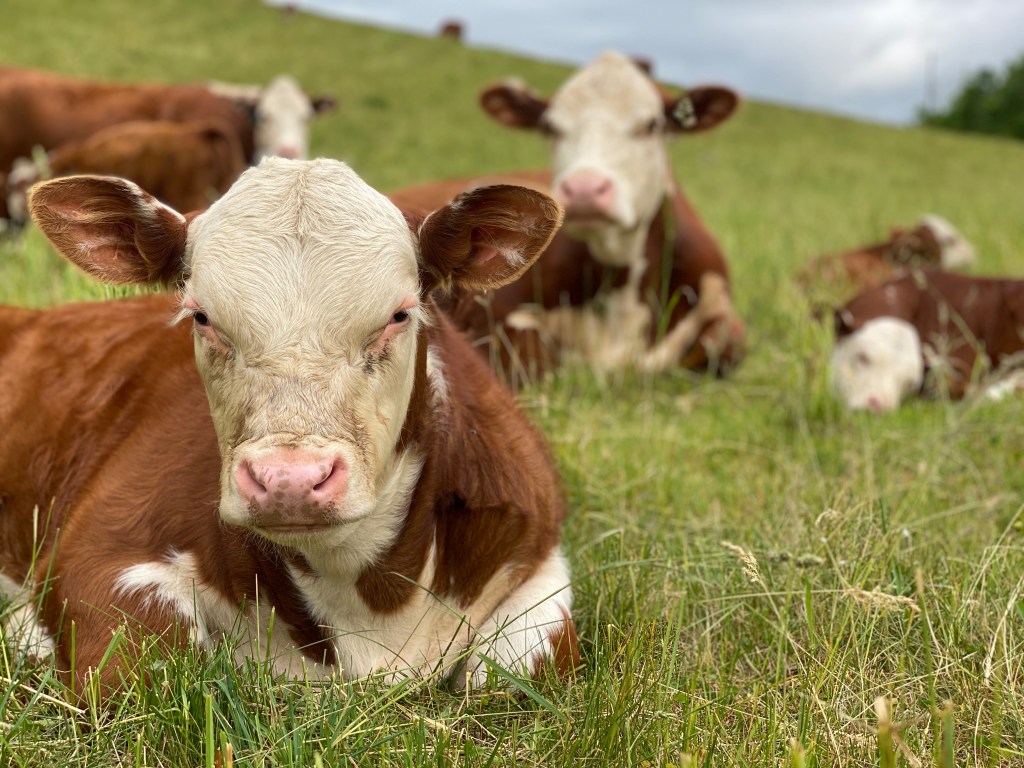
There was a cow pile up on the grassy highway — a country folk’s version of those big city morning traffic jams. The exit ramp — or in this case — the exit gate leading to a scrumptious buffet of red clover — was closed. The cows were not happy. They wanted to get to that field. No other field would do.
In their effort to get where they wanted to be, they began nudging one another — politely, at first. It didn’t take long, though, for the polite nudging to turn into full-fledge field rage. It wasn’t pretty, and as I watched I found myself wishing I was among the more genteel breed known as the “New Jersey driver.”
(I know. I can’t even believe I wrote such a sentence. But these cows were getting ugly and made the New Jersey traffic jams I remember from my life in the Garden State seem like a walk in the park.)
One frisky girl, who wanted to be first in line at the gate, bucked an older lady with a bummed back leg out of the way. Another deceivingly docile bovine revealed her dark side, sneaking up behind her frisky friend and sideswiping her with her sturdy broad back.
The young ones looked on with big brown eyes, taking note of the nudging, bucking and side swiping techniques being displayed. It was then a calf darted from her friends and galloped with great glee into the mayhem, not realizing how fast she was going and when to start slowing down. A fender bender involving a cow’s butt ensued, creating more bellowing echoing throughout the valley.
My neighbor finally came and opened the gate, almost getting stampeded in the process. The cows were finally where they wanted to be and soon settled down to a morning of lackadaisical grazing.
What they failed to realize was the field where they were seemingly stuck in was actually a place of opportunity and abundance. In their stubbornness to get where they wanted to be — in a familiar field offering the same menu items as the day before — they weren’t noticing they were trampling on fresh grass nor that the blanket of meadow buttercup beneath their hoofs would have satisfied their hunger.
Back to a familiar field
Our sanctuary has opened for traditional Sunday worship. We opened mid-June — earlier than most of my friend’s churches that I know of. Many of my friends — clergy and non-clergy alike — are surprised that I have to report to the building on a Sunday morning.
Some concerned colleagues have even asked me if the decision was made carefully? Was there a detailed risk assessment done? Was medical data and case reports from the local municipality weighed carefully? I have answered the best I could, praying that we have done our due diligence.
So far, those 65 and older worshipers have been sitting six feet apart and have been dutifully wearing masks. But I can see the resolve to be safe slipping already. It’s been suggested to me that perhaps we can reintroduce responsive prayers and maybe a unison prayer of confession. Bulletins can return along with pew Bibles, right?
A request has even come in for a fish fry to be held later this summer, with dinner being enjoyed seated at tables elbow to elbow. (That is not going to happen, trust me.) And, at a recent socially distanced session meeting, two elders, masks removed from their face, leaned into one another, deep in conversation. I think my blood pressure went up a notch or two as I reminded them to sit six feet apart and put their masks back on.
A revealing question
It is in these situations that a question asked of a friend comes to mind. It doesn’t take much for this question to gnaw at me. It has taken up prime real estate in my head since I heard it. It’s a question that goes beyond the daunting health concerns of COVID-19 and reveals a sickness of the soul that no one seems to view just as deadly as any coronavirus. It is a seemingly innocent question that can reveal what we are not ready to have revealed.
Why do you want to be in a sanctuary on a Sunday morning?
Because virtual worship is not really church. Because the sanctuary is just so pretty to sit in. Because I miss talking to my friends. Because I need to be with other people on a Sunday morning. These are answers I have heard. But I wonder, how would you answer? Why do you want to be in a sanctuary for worship on a Sunday morning? I am not saying that this is not a holy place to be in nor that we don’t need such a worship service.
All I am asking is for us to really search our hearts for an honest answer, so that that honest answer might reveal where our hearts truly lie when it comes to completely serving God and God alone.
And so, let me poke a bit further and ask you to answer that question not from the perspective of what you want, but from the perspective of what God wants? Don’t rush to answer. Don’t get defensive and begin defending traditional Sunday worship. Let those defensives down. Explore how this question makes you feel and ask why you are feeling what you are feeling?
Juggling and struggling
I am now juggling traditional Sunday worship in the sanctuary on top of a growing virtual worship community. My Saturdays used to have a bit more “me” time, but not anymore. In addition to sermon prep for traditional worship, I now spend a full day working on worship videos. Saturday nights used to be an early night for me to pray and prepare for Sunday in-person worship. Saturday nights now go beyond midnight as I put finishing touches on videos and finalize Sunday worship. This schedule is not sustainable. I know that.
But where do I go from here? What is my answer to wanting to maintain traditional worship in the sanctuary?
I wrestle with the questions and so badly want to find the answers, but the cows are bellowing. They want the gate to the familiar field opened. They want to graze on the tasty delights that satisfy their hunger — not the hunger of the world. And in their bellowing, they cannot see what I can see. The very place they are bellowing to be free of is in fact blessed with opportunities and abundance. There is fresh green grass and a beautiful blanket of meadow buttercup waiting for the church to graze upon.
This article appears on Pastor Donna’s blog for Presbyterians Today, “Barn Boots and Blessings.”
Taking some downtime on my birthday to enjoy some tea on the porch while listening to the rain — a perfect way to make time for God.
Join me as I discuss the theology of the wattle fence. A wattle what? Hit play and find out. But before you do, let me thank you for your kind words and support of this fledgling media ministry. I enjoy spending time with you each week and sharing with you the God moments I see all around. It is a joy and I cannot thank God enough for you, my virtual congregation!
Blessings,
Pastor Donna
The Power of Lament — June 14, 2020
By Donna Frischknecht Jackson
The “For Sale” sign in front of what was known as the oldest house in Rupert was like a love letter written just for me — wooing me that crisp fall morning a decade ago to make it my home. They say love is blind, and so when others pointed out its imperfections, I was there to defend the little clapboard Cape Cod. “It’s too close to the road,” some said. “It’s authentic,” I replied. Eighteenth century homes often wound up with the road at their doorstep. It’s the price to pay for modernity. Luckily, though, the road wasn’t a busy one. Others remarked how tiny and rustic it was. “Tiny” and “rustic,” though, were two of my favorite adjectives.
I’ll admit it. It was love at first sight. While the house had me at hello, it went the extra mile wining and dining me, showing me a spacious yard, views of the Green Mountains and, to boot, a trail behind the property that was perfect for running. My Vermont home was a long-time dream come true. Ever since I was a little girl, wearing her “Little House on the Prairie” bonnet and carrying a wicker basket around pretending to gather up herbs that were really dandelions in the tiny New Jersey yard of my childhood, I dreamt of a rural Colonial home to call my own. Even when I moved away to serve churches in New York and Maryland, the Vermont home remained just that. Home. And it always embraced me warmly when I returned. Nowadays, though, that embrace is waning.
At first, I wasn’t quite sure what was going on. Was it me having a problem with where I was in my life or was it actually where I was in life that was the problem? Was this unhappiness a home version of a seven-year itch? Was my dream come true simply maturing and evolving? Or was it something a whole lot scarier and disconcerting? Was the Spirit of God, which is never stagnant, picking up velocity trying her best to swish me on to the what next in life? I have known these Spirit winds before, and they have uprooted me many times and in many unsettling ways. What was going on? Why was I noticing things I’ve never noticed before?
When I remarked to my husband how busy our once quiet road had become in just the last year, he said what every husband who is afraid of where his wife’s comment might be leading said: “It’s all in your head.” I knew it wasn’t, though. Confirmation soon came when my neighbor mentioned the heavy traffic — mind you, I didn’t broach this topic with him — and how things in our little slice-of-rural heaven were changing and changing fast.
I have noticed local names that graced weathered mailboxes fading from the landscape. With no jobs in the areas, young families with ties to those legendary names have moved out, leaving empty houses to be snatched up by, dare I say, “outsiders” — folks from the cities that bring with them city ideas of living. I can’t really bash these people. I am one of them. I come from North New Jersey, but I came seeking not to change rural life, but to embrace it. Plus, I married a local boy, so I’ve been accepted by default. Being a pastor, too, also helps one assimilate a bit more quickly into a rural community.
There is this sense of history — of ties to the land — evaporating quickly, and new names on freshly painted mailboxes bring change. For example, a proposal recently passed to turn an old general store into a community center, complete with a green area for having picnics. Not sure why that was needed considering every house in the area comes with wide-open green space to picnic, if so desired. And a community center? The area schools are dwindling, not many children around to entertain, and the neighboring village already has a struggling community center. Yet, another one is underway.
If the community center was enough to scratch your head, there was the beaver dam debacle. Yes, you read correctly. Beavers lived in a swampy spot on the trail behind my home. I loved visiting them and watching the progress of their work. But one day, the dam was decimated. The water was drained and the nibbled birch logs that were erected into little huts were pushed aside by a bulldozer. I soon learned a new neighbor from out-of-state “had something done” about the beavers.
Another new neighbor is now calling for the country post office to be opened 24-7 with a fluorescent-lit vestibule like that which he had while living in California. And don’t get me going about the new neighbor who likes to sit in the field across from our home and shoot his gun. What exactly he is hunting, I am not sure? All I know is that his shooting is almost always out of season.
All of this has made me unsettled. But today was the day, the tears finally came. I was starting my morning run, feeling the joy in my soul rev up as I my legs sprinted through the tall grass blowing in the back field of my home. I was making my way to the trail that has always been a magical haven for me. It has been a place to clear my head, pray, feel closer to God.
Today, though, my run came to a screeching halt as I got to the edge of the trail. In front of me, were three large construction vehicles, some paver of sorts, a truck filled with gravel, and another piece of equipment. Instead of a soft bed of leaves and grass and fallen twigs to run upon, there was mean looking gravel. Instead of the rich, deep earthy smell of dirt still wet from the morning dew, I could small asphalt. Instead of deer, rabbit or even fox prints imprinted on the ground, reminding me that I was never alone on this trail, there was a smooth expanse of concrete. My beloved trail had been widened. My natural sanctuary had been paved. It had been made to look like the overcrowded, suburban trails that I vowed I would never run on again. I stood there staring, feeling an all-too-familiar feeling.
New York City had once courted me and wrote me love letter early in my adult life and I enthusiastically said “yes” to its offer to live together. After many happy years, though, something just wasn’t right. Things began to change. First the Irish pub down the block from my co-op was torn down to make way for a large office building. Then the co-op’s rooftop, the coveted spot for viewing Macy’s Fourth of July fireworks, was turned into a posh penthouse for millions of dollars. I would now have to brave the crowds on my way to the waterfront firework display. These might seem like trivial things, but when you begin falling out of love the trivial becomes monumental.
I remember one night sitting at an outside table on Columbus Avenue with a friend nursing my drink. As the ice cubes melted and watered down the cocktail, I shared with her the same question I now ask: Is it me having a problem with where I am in my life or is it actually where I am in life that is the problem? I then asked her, “When does one know when it is time to move on from a longed for and realized dream?”
As the setting summer sun washed the apartment buildings surrounding us on fire with beautiful reds and oranges, my heart ached. I would miss the city and all it had to offer. Yet another dream was now tugging at me. My friend listened, and after I was done speaking, she smiled and shrugged and nonchalantly observed: “Your dream is breaking up with you.” Within a year, my Manhattan co-op was on the market and I was placing my well-worn quilt on a rocking chair in front of an 18th century hearth.
As with all break ups, the breaking up with a dream comes with heartache. And yet, when a dream breaks up with you, what choice do you have but to accept the time has come to say good-bye. If you fight to hold on to it, it will just lead to more unhappiness as you try to make a life that you have outgrown work.
No, when your dream breaks up with you it’s best to thank that dream for all the wonderful memories and for the space is gave you to discover more of who you really are. You thank that dream and the lessons learned. You remain strong, but more importantly, you remain open to love that is still to come in the way of all those amazing God possibilities that seem so impossible.
As my feet hit the paved trail this morning, I wiped away my tears. Breaking up is hard to do, but there is a dream waiting to be realized — one that can only be found on unpaved paths.

The author’s beloved natural trail, once shaded with trees and rich with soft dirt, has now been widened and paved, leading her to wonder what new “unpaved” paths God has for her.
June 1.
I knew this was going to happen. I knew I would feel this way as the world begins to reopen. I woke up not feeling relieved. I woke up feeling as if a freight train ran me over. I am tired and achy. I feel as if everything is going in slow motion. The sun is shining here in Vermont. I look out the window and everything is so green — so full of life. The bluebirds are in the apple tree singing. I stand numbly watching and listening. A friend once joked that I live in some Disney movie with those birds singing around me. Hmm? That would make me a Disney princess. Dear god, help me.
But sometimes it can feel like I am in some romantic movie — a New York City editor who was so enthralled with the fashion industry back in the day, who lived in a pre-war, doorman co-op, who attended black tie galas for work, who dated her share of eligible bachelors, some of whom had a house in the Hamptons, only to have her share of heartaches that went with that shallow search for Mr. Right. Then one crisp early fall New York City day, I met God.
That chance meeting with God (okay, Presbyterian friends, slam my theology and say with God there are no chance meetings … ) led me to embark on a soul-searching adventure as I hesitantly stepped onto a path that was only walkable in barn boots. It was a path into ministry, rural ministry to be exact. Who would have thought that in a place where there were less people, less opportunities, less of everything, that I would find abundance — an abundance of love, new dreams, joy, grace and healing.
It has been life changing. It has been a blessing. But I have to admit, lately, I feel so disconnected from the real world. I mean, really, I have bluebirds singing in my apple tree.
I find myself asking God, what the heck are you doing in my life? How are you really using me to help heal this shattered world? Why am I in “safe” little Vermont with bluebirds all around me while the streets of Minnesota, Philadelphia, New York City, Nashville…name any city in the country and chances are it is burning, literally and figuratively with hate.
“Use me, Lord!” I cry. I want to be your peacemaker. I want to put the fires of hate out. I want to shout the Word of God on crowded streets, not in empty pastures. I cry, but is it only the birds who hear? Or even my neighbor’s cows?
In spite of how down I feel and, even in all my doubt and questioning, I still know that deep down in my heart God is using me, even if right now I feel just so darn useless. God has the plan. (Okay, there you go Presbyterian friends. I’ve just conceded that you are right. There are no chance meetings with God, but I will still defend my “accidental” in “Accidental Country Pastor.”)
I cry out and God hears because I am told that the Spirit intercedes on my behalf, even when that primal cry for guidance, help, comfort is stuck in my throat. God hears. Perhaps, then, crying out to Jesus is enough right now? Perhaps it’s the only thing I need to do when I have no idea what to do or what my next step is or how to help? Perhaps my cry is what the world needs? Could it be that the world needs your cry, too?
Today is June 1. I woke up feeling what I knew I would feel as the world around me begins reopening. I feel agitated. I feel sad. I feel numb. I hear the joy in the haircuts being scheduled, the restaurants opening and I feel as if I am being lost in it all as I silently scream, “Stop! Wait! We have a problem. We are far from healed. We are no closer to being healthy.”
We need to cry out to God for healing, not just from a virus named COVID-19, but from the virus of hate and racism.
We NEED time to pray, repent and confess. We need this time, this national day of mourning and lament, because the world is reopening. It is reopening painful wounds. It is reopening incessant hate. It is reopening injustices. It is reopening inequalities. It is reopening white supremacy. The world is reopening and I feel like crap. And so, I lament. I mourn. I stand in safe little Vermont and I cry out to Jesus. The bluebirds stop their singing. They hear. The cows stop their mooing. They hear as well. I continue to lament, mourn and cry. I do so because the world, so focused on reopening all the wrong things, needs to hear the voices of the faithful. We have had enough. We have seen a glimpse of God’s new creation. We were able to dream again and hope. But the world is reopening and the clouds are swiftly gathering again. And so, I cry knowing that God hears, even in safe little Vermont.
https://vimeo.com/424131502Our nation has passed a grievous point in history: 100,000 Americans have died from COVID-19. As people of faith, we cannot allow this grim number to go unnoticed.…
Pentecost, May 31, 2020

